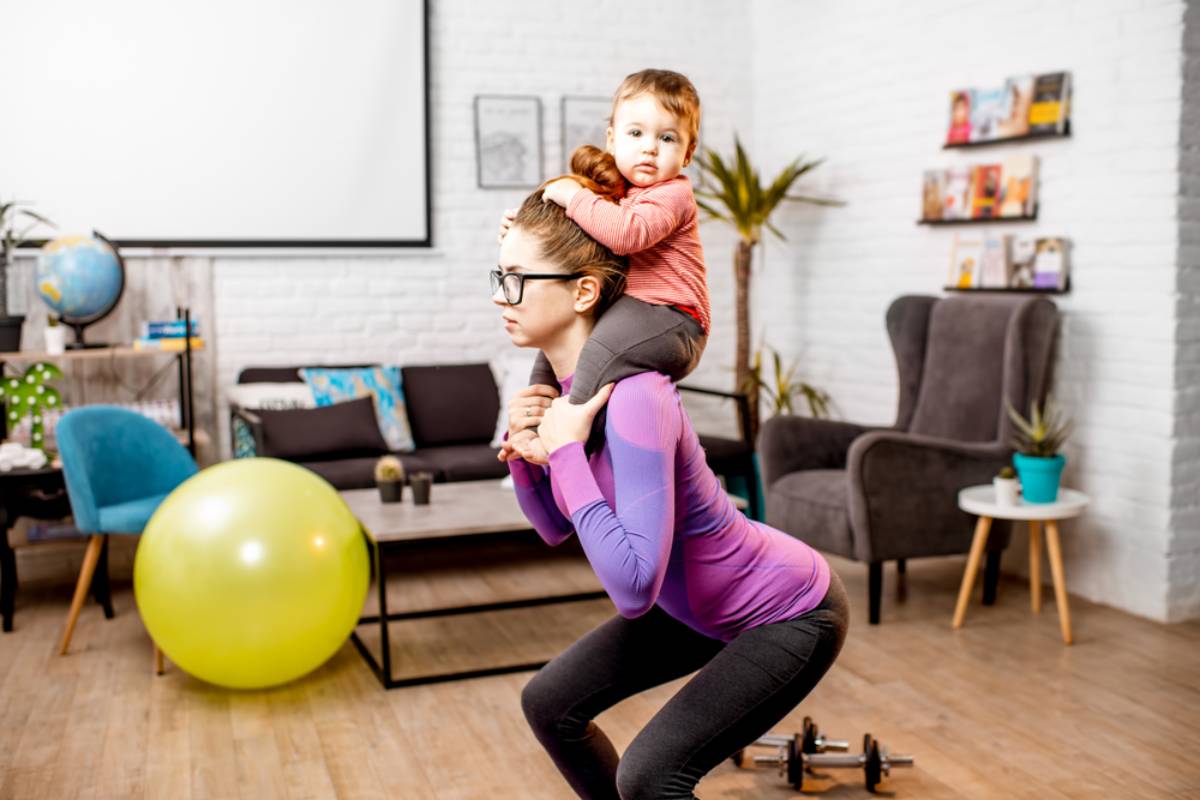
A Mom Did 200+ Squats Every Time Her 4-Year-Old Said “Mom,” Then Turned the Same Word Into a $405 Challenge for Her Husband

Jess Sharp, a 34-year-old mother from upstate New York, swapped her usual morning walk for an exercise challenge built around a word she hears constantly. In a September 14 report, the New York Post described how she decided to squat every time someone called her “Mom.” Her four-year-old daughter, Amelia, quickly became the unexpected source of most of those cues.
The rule was simple: every time Sharp heard the word, she had to complete a squat. Rather than setting aside a dedicated workout session, she incorporated movement into the everyday conversations happening at home. What she could not fully anticipate was how quickly the repetitions would accumulate.
Amelia Became the Unofficial Workout Timer
In the TikTok video documenting the challenge, Sharp explains her idea and follows through as Amelia talks to her. The little girl repeats a question about what her mother is making several times in quick succession, triggering another round of squats. Instead of relying on a timer or workout app, Sharp used her daughter’s everyday chatter as the signal to move.
Sharp later explained that she expected the final tally to be high because she already knew how frequently Amelia called for her. However, anticipating a large number and physically completing more than 200 squats proved to be two very different experiences. The challenge transformed a familiar parenting routine into a running count that was difficult to ignore.
More Than 200 Reps Accumulated Before the Day Was Over
The tally eventually passed 200 squats, an impressive number for a challenge that began with such a straightforward rule. Sharp noted that the more-than-200 repetitions did not even represent a full day of hearing the word “Mom.” That detail made the total particularly striking because the exercise had accumulated during only part of her ordinary routine.
The squats were spread across separate moments rather than completed in one continuous set. Each time Amelia called for her mother, another repetition was added to the total. By counting those individual moments together, Sharp discovered just how much exercise the familiar word could produce.
Seeing the Number Was Different From Feeling It
Sharp acknowledged that she had expected the tally to be substantial because she was already familiar with how often she heard “Mom.” Still, knowing that the total would be high did not prepare her for the physical experience of completing more than 200 repetitions. The difference between seeing the number and actually doing the work became one of the defining details of her story.
The exercise arrived in small bursts, but every squat still required her to lower and raise her body. Because the repetitions were scattered throughout her routine, the growing workload could be easy to underestimate while it was happening. The physical consequences became much clearer once the challenge was over.
The Comments Turned Her Legs Into a Running Joke
The video prompted a mixture of amusement, surprise, and concern from viewers who recognized the situation. One commenter jokingly predicted that Sharp would become “quadzilla” by the end of the week, while another imagined how difficult the challenge would be in a household with six children. Their reactions highlighted how quickly a playful idea could become an unexpectedly demanding workout.
The comments did not establish that the challenge would produce any particular fitness result. Instead, they showed how recognizable the premise was to parents familiar with repeated requests from young children. The same everyday habit that made the video funny also explained how a simple rule could lead to such a high number of repetitions.
The Aftereffect Lasted Two Days
Sharp’s challenge came with a physical consequence that went beyond a surprisingly high tally. She reported being sore for two days afterward, describing the experience by saying, “I was so sore I could barely go up and down the stairs!” What started as a playful experiment had made ordinary movement around her home difficult.
Her experience was a personal account, not a controlled fitness test or a recommendation for other parents to complete the same number of repetitions. The story does not establish that everyone attempting a similar challenge would experience the same soreness. It does illustrate how separate bouts of exercise can accumulate into a substantial workload.
She Did Not Repeat the Squat Challenge
Despite the attention the idea attracted, Sharp did not repeat the exact squat challenge, according to the published report. The initial experiment had already demonstrated how demanding the accumulated repetitions could become. Rather than making the same routine a regular workout, she went on to explore other ways of connecting exercise with the unpredictability of family life.
That distinction is important because the challenge was not presented as a structured training program. It was an experiment built around a recurring feature of parenting, with an outcome that surprised even the person doing it. Later variations retained the playful premise while changing the exercise involved.
She Switched From Squats to Burpees
One variation Sharp tried was a burpee challenge linked to questions, extending the idea beyond the original squat routine. Instead of responding to the word “Mom” with a squat, the follow-up concept connected movement to another conversational cue. The basic premise remained the same: everyday interactions could determine when another repetition began.
The reported variation did not come with a detailed training plan or a specified target number of burpees. It was another example of Sharp experimenting with short bouts of movement around the demands of motherhood. The shift also demonstrated that the original idea was flexible enough to accommodate a different exercise.
The Word “Mom” Also Became a Money Challenge
Sharp later found another way to put the frequent calls to use, this time involving her husband. She established a rule under which he would pay her one dollar for every time she was called “Mom” over the course of a day. The familiar word that had previously triggered squats now had a dollar value attached to it.
Unlike the original workout, this version did not require Sharp to complete a squat after each call. Instead, the challenge depended on keeping track of how many times the word was spoken. It turned the same recurring feature of family life into a counting game with a financial outcome.
The Final Count Came to 405 Calls
The money challenge ended with 405 mentions of “Mom,” Sharp reported. Under the one-dollar rule, that tally amounted to $405, giving the story an unexpected financial twist. The number also offered another illustration of just how frequently a young child might call for a parent during an ordinary day.
The reported outcome was tied to a personal arrangement within Sharp’s household, not an ongoing income stream or a guaranteed way for other parents to make money. It was a one-day challenge built around an agreed rule. Even so, the final figure made the original idea seem less surprising in retrospect: the word appeared frequently enough to generate both hundreds of squats and hundreds of dollars in a separate game.
Other Parents Saw Themselves in the Idea
Sharp told the New York Post that mothers had been commenting that they wanted to try the squat challenge or tagging other mothers in the discussion. The report did not establish how many people actually attempted it, but those responses suggested the idea had resonated beyond her own household. Its appeal came from a parenting experience that many people with young children would immediately recognize.
The central joke was simple: a parent might hear “Mom” so often that the frequency becomes almost invisible until someone starts counting. By turning each occurrence into a task, Sharp made that background feature of family life visible in a new way. The concept needed no specialized equipment or elaborate setup, only a recurring word and a willingness to respond to it with movement.
A 2022 Study Adds Broader Context
The challenge also connects with a wider issue researchers have examined: finding opportunities for physical activity while caring for young children. A 2022 study published in PLOS ONE analyzed physical-activity data from 848 mothers participating in the United Kingdom’s Southampton Women’s Survey. The researchers examined how the ages and numbers of children in a household were associated with mothers’ activity levels.
Fewer than half of the mothers in the study’s groups met the physical-activity guidelines used in the research. At the assessment when the study’s index children were around four years old, 29.8% of mothers with only younger children met those guidelines. The findings describe a particular British cohort and should not be interpreted as a direct measurement of Sharp’s activity or of every parent today.
The Viral Trick Is Not the Same as Weekly Exercise Guidance
The Centers for Disease Control and Prevention’s guidance for adults recommends at least 150 minutes of moderate-intensity aerobic activity each week, or 75 minutes of vigorous-intensity activity, alongside muscle-strengthening activity on two or more days. The agency also explains that physical activity can be spread across shorter periods rather than completed all at once. Short bursts can therefore contribute to a broader routine when they meet the relevant activity and intensity criteria.
Sharp’s experiment was not designed or tested as a fitness prescription, and her experience does not establish that every parent should imitate her exact tally. Instead, the challenge showed how an ordinary parenting interaction could become an unexpected prompt for movement, even if the resulting workload was greater than anticipated. Between the 200-plus squats, the burpee variation, and the $405 follow-up game, one familiar word became the unlikely centerpiece of a story about parenting, exercise, and the things that happen when someone finally starts counting.