More Than 14,000 NYC Kids Are Learning at Home, and the Reasons Their Parents Chose to Leave Classrooms Go Far Beyond Test Scores

The New York Post’s September 9 report on New York City homeschooling cited the latest figures for the 2025–26 school year, putting the number of homeschooled students at 53,905 statewide and more than 14,000 in New York City. The statewide total has more than tripled since the 2009–10 school year, according to the report’s analysis of education data. Behind those figures are families making very different choices about how and where their children learn.
The numbers measure the scale of homeschooling, but they do not establish that one educational approach works better for every child. They also do not mean that every family left a public school or made the change because of poor academic results. The individual stories reveal how educational expectations, work schedules, and the desire for more family time can all influence the decision.
A Boom That Started Before the Latest School Debate
The increase did not begin with the latest school-year figures. An Empire Center for Public Policy analysis of New York education data found that statewide homeschooling enrollment increased 178% between 2013 and 2023, while traditional district public school enrollment fell 13% over the same period and charter school enrollment rose 125%. The analysis also found that homeschooling increased 324% across New York City between 2017 and 2023.
These figures cover different time periods, so they should not be combined into a single growth rate. They do, however, show that homeschooling was expanding before the latest debates about classroom performance and the long-term effects of pandemic disruptions. The more recent enrollment figures suggest that home education remains a significant option for families throughout the city.
Parents Often Arrive at Homeschooling for More Than One Reason
Parents rarely make the decision for one universal reason. In a 2019 national survey, the federal National Center for Education Statistics found that 80.3% of homeschooling parents cited concerns about the school environment, 72.6% cited dissatisfaction with academic instruction, and 54.2% wanted to spend more time together as a family, according to its tabulation of reasons parents gave for homeschooling. Families could select multiple reasons, meaning these motivations were not mutually exclusive.
Those statistics describe American homeschooling families in 2019, rather than the specific New York families profiled in 2026. Still, they help explain why one family’s decision might center on educational quality while another’s involves family routines, safety concerns, or greater control over the curriculum. The stories of New York parents reflect this range of priorities instead of a single explanation for the increase.
One Mother’s Decision Began With Her Daughter’s Needs
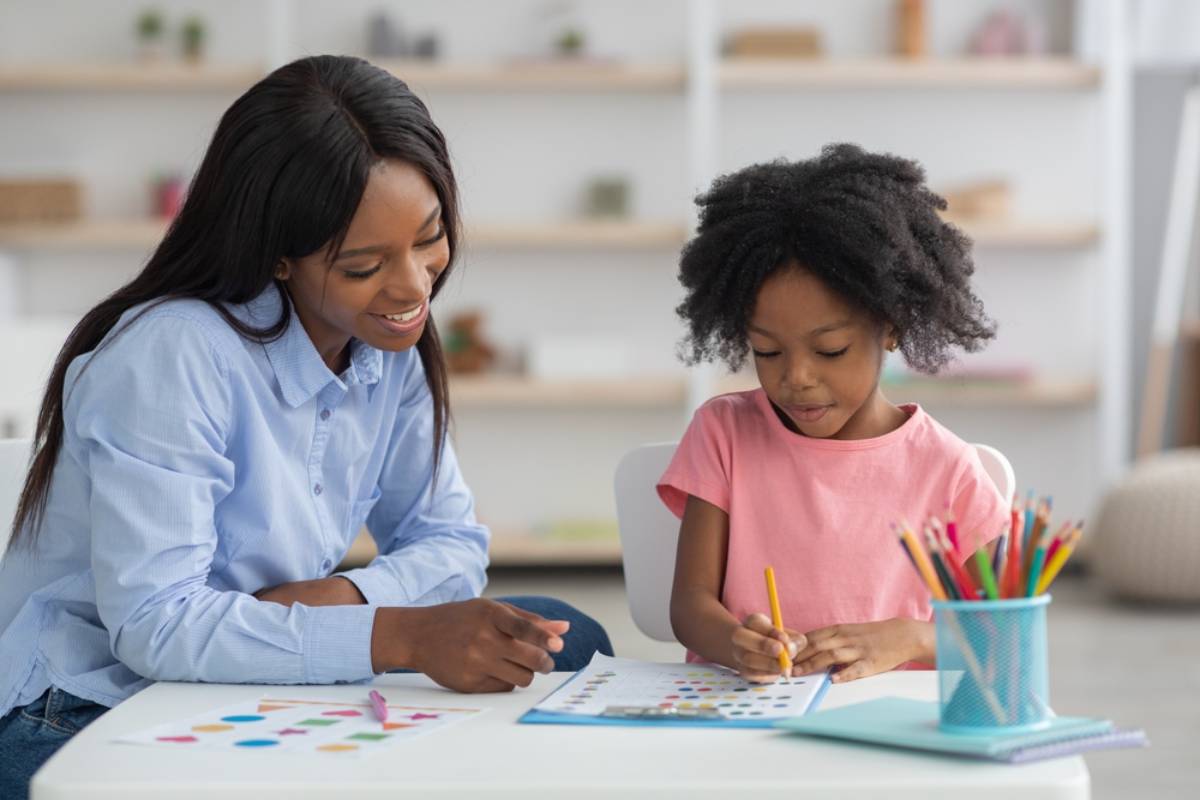
Vivianne Wright, a Harlem mother who was 46 when profiled, began homeschooling her daughter, Violetta, when the child was four. Wright had not originally planned to take responsibility for her daughter’s education, but she recognized that Violetta was academically advanced and wanted to provide instruction that matched her abilities. Wright’s own work as an Advanced Placement test tutor also made the fixed hours of conventional school difficult to reconcile with the family’s schedule.
For Wright, the choice became both an educational decision and a practical adjustment to everyday life. Homeschooling gave her greater control over the pace of lessons, the subjects covered, and the way her daughter spent her time. Rather than treating education as a schedule that could not be changed, she could organize it around the child’s individual interests and needs.
Violetta’s School Day Looks Nothing Like a Traditional Timetable
Violetta’s home curriculum extends well beyond ordinary worksheets and textbook assignments. The reported schedule includes extended mathematics sessions, projects comparing folklore from different cultures, and science experiments that she designs herself. Outside those academic subjects, she practices judo three times a week, attends art classes weekly, and makes time for chess and piano.
The original report also said Violetta placed second in an international essay competition at age eight, making her the youngest contestant and the only homeschooled student to place. That accomplishment is a notable part of one child’s story, not proof that homeschooling automatically produces stronger writers or higher grades. It illustrates the type of individual progress Wright wanted her daughter’s education to accommodate.
Adrienne Jensen Once Thought Homeschooling Was Fringe
Adrienne Jensen’s path began with a different kind of discovery. The 45-year-old Upper West Side mother of four first encountered homeschooling while browsing cloth-diapering discussions after having her first child, having initially viewed home education as an unusual choice. As she learned more about it, she became interested in providing a rigorous education without having to depend on securing a particular teacher or moving to a neighborhood with schools she considered suitable.
Jensen now homeschools three of her children, who were ages 16, 14, and 12 when she was profiled, while her eldest daughter, then 19, was a sophomore at Cornell University. By that point, Jensen had spent 15 years homeschooling her children and said the attractions had evolved beyond academic rigor to include time, freedom, and shared experiences. Her account shows how a family’s reasons for choosing homeschooling can change as children grow and household priorities develop.
New York City Itself Becomes Part of the Classroom
Jensen’s approach makes use of the educational opportunities scattered throughout the city. Her children have taken classes at the Metropolitan Museum of Art and the New-York Historical Society, gone birding in Central Park, and participated in book and running clubs. They have also attended field trips and activities with other homeschooled children who share their interests.
This kind of education depends on parents arranging learning opportunities beyond the home. Museums, parks, libraries, and historical sites can become places to study subjects through direct experience rather than through classroom assignments alone. For Jensen’s family, the approach also creates opportunities for children to learn alongside others without depending on a conventional school schedule.
For Another Family, the School Schedule Was the Problem
Carolina Brinkman, a 40-year-old mother in Astoria, chose homeschooling for a reason that differed from Wright’s focus on academic pacing. She had homeschooled her four children, ages 15, 14, 12, and 10 when profiled, since kindergarten. Their father works as a chef with demanding overnight hours, and Brinkman explained that conventional school hours would leave the family with less time together.
Her approach incorporates libraries, museums, parks, playgrounds, and historical sites into the children’s education. In this household, the schedule is not merely a matter of deciding when lessons begin and end; it also affects when family members can spend time together. The experience shows that homeschooling can be driven by a family’s working arrangements and relationships as much as by dissatisfaction with a particular subject or test.
Academic Test Scores Add Context, but They Do Not Tell the Whole Story
Academic performance remains part of the wider debate surrounding New York’s education system. Preliminary results released by the New York State Education Department for the 2025–26 school year showed that 48% of students in grades 3 through 8 statewide were proficient in English language arts, while 57% were proficient in mathematics, according to the department’s announcement of the state assessment results. These figures cover New York State as a whole, not New York City alone.
Results like these help explain why some parents place a high priority on academic rigor and individualized instruction. However, statewide test results do not show how homeschooled students would have performed under the same circumstances. They also cannot demonstrate that moving a child into a home-based program will automatically improve that child’s academic performance.
Homeschooling Does Not Automatically Mean Isolation
Children who learn at home can still have regular contact with friends, participate in group activities, and build relationships outside their families. A New York Magazine report on New York City’s homeschooling community described a weekly gathering at Heckscher Playground in Central Park, where children played soccer, cards, and other games while parents connected and coordinated activities. The report also described families using meetups, cooperative learning groups, and outside classes to create opportunities for social interaction.
Those opportunities, however, require some planning rather than appearing automatically through school attendance. Parents may need to arrange recurring group activities, lessons, clubs, and friendships instead of relying on a school’s daily schedule to bring classmates together. The extent and quality of those opportunities can differ considerably from one household to another.
Research Offers Clues, Not a Final Verdict
Research into homeschooling outcomes offers evidence for the discussion, but it does not provide a simple verdict that one form of education is always superior. An updated systematic review published in the Peabody Journal of Education examined selected research on academic achievement and reported positive outcomes for homeschooled students in 15 of 24 studies, no difference in four, mixed results in four, and better results for conventionally schooled students in one. Its examination of social and emotional development also found a mixture of positive, mixed, and neutral findings.
The review’s authors cautioned that research comparisons can be affected by differences in family backgrounds, parental involvement, and the characteristics of children whose parents choose homeschooling. These factors make it difficult to determine whether the schooling arrangement itself caused a particular outcome. The evidence supports a more careful conclusion: homeschooling can work well for some students, but individual results depend on circumstances that cannot be reduced to enrollment figures alone.
The Freedom Comes With Practical Costs
Greater control over a child’s education does not mean that families receive all the resources available through a school. New York City Public Schools explains that homeschooled students do not receive instruction, computers, textbooks, or access to most school-based programs, including sports and extracurricular activities. They also do not receive a New York State high school diploma.
Families therefore need to consider how they will obtain learning materials and arrange additional instruction or activities. Expenses can vary depending on the curriculum, tutors, outside classes, and other educational opportunities a family chooses to provide. Parents must also decide how much time they can devote to teaching while managing employment and other responsibilities.
Parents Must Document the Education They Provide
Homeschooling in New York involves formal requirements beyond keeping a child at home and selecting books. Families must submit a letter of intent, an Individualized Home Instruction Plan outlining the educational program, quarterly progress reports, and an annual assessment under the state’s rules. The city requires a minimum of 900 instructional hours each year for grades 1 through 6 and 990 hours for grades 7 through 12.
Families beginning homeschooling during the school year must submit their letter of intent within 14 days of starting. Quarterly documentation tracks instructional hours and the materials covered, while the annual assessment evaluates the child’s progress and must be submitted by June 30. Assessment options vary by grade, with standardized testing required annually for students in grades 9 through 12.
New York’s Oversight Debate Is Still Developing
The growing use of home instruction has also attracted attention from state policymakers concerned about educational continuity and child protection. On October 5, 2026, New York State Sen. Patricia Fahy announced two proposed bills, one establishing an early review for certain students who transition to homeschooling after severe chronic absenteeism and another restricting home instruction in specified circumstances involving child abuse or neglect. The state Senate’s announcement presented the proposals as safeguards for vulnerable children while preserving the broader right to home instruction.
The announcement cited state education data indicating that students who transitioned to home instruction during the 2024–25 school year were more than three times as likely as their peers to have been chronically absent. That comparison concerns attendance among students who made the transition during the school year; it does not establish that homeschooling caused absenteeism or describe the families profiled in the New York City report. The Senate’s posted legislative status information lists the proposals in the Senate Rules Committee, meaning they had not become law as of the latest posted status.
The Bigger Question Is What Families Need From School
The experiences of Wright, Jensen, and Brinkman show that the decision to homeschool does not follow a single formula. One family may prioritize a child’s academic pace, another may want more opportunities to explore the city, and another may need a school schedule that better fits the parents’ working hours. Their reasons differ, even though each family has chosen to take direct responsibility for its children’s education.
The increase in homeschooling does not settle the debate over public school quality or prove that every home-based program offers a better fit. It does show that more New York families are willing to organize education around their children’s needs and their household circumstances rather than a conventional classroom timetable. Ultimately, the success of any approach depends on whether children receive sustained instruction, make meaningful progress, and have opportunities to develop both academically and socially.