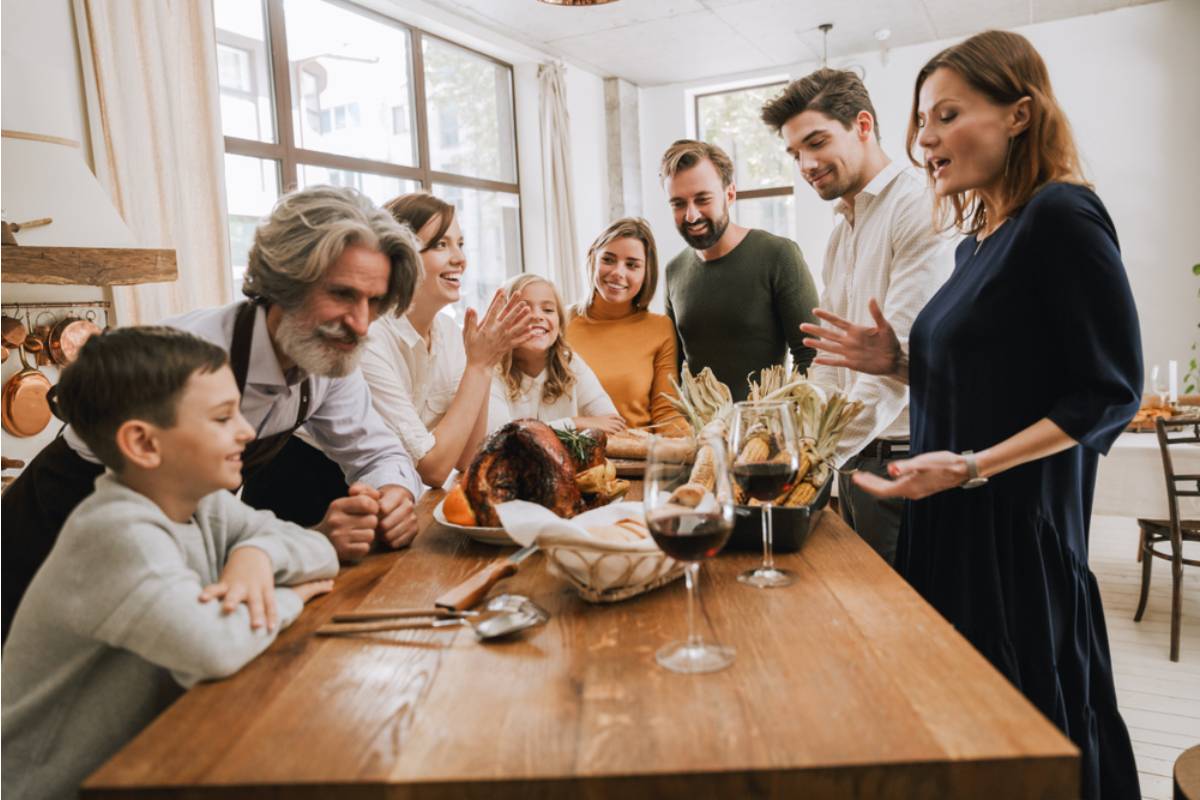
A Dad Says His Family’s 20-Person Thanksgiving Has Outgrown Every House, and His Cousins Still Asked Him to Host It

For as long as he could remember, a person had spent Thanksgiving with his mother’s sister and her family. The gathering continued even after his aunt passed away, becoming one of those traditions that seemed too established to question. Over the years, he attended as a child, brought his former wife and children, cooked plenty of dishes, and took turns helping host.
The tradition had changed shape as the family grew and circumstances changed. One cousin hosted for nearly a decade, but that arrangement ended after her grandmother-in-law passed away. From there, the family began rotating between different homes, trying to keep their long-running Thanksgiving gathering alive.
The Hosting Duties Kept Moving Around
Eventually, Thanksgiving became something of a traveling family production. Some years it was at his mother’s house, other years at his uncle’s, and on one occasion everyone made the long trip to another cousin’s home about nine hours away. Nobody seemed to have a permanent solution, but the family kept finding ways to make the gathering happen.
That arrangement worked while the family was smaller and the homes could handle the crowd. But the dinner had gradually grown to around 20 people, and every move from one house to another brought a new set of challenges. What once felt like a cozy family meal was starting to resemble a logistical operation.
Then He Asked Who Was Hosting
This year, the person decided it was time to figure things out early. He texted two of his cousins to ask whether they had any thoughts about who should host Thanksgiving. He apparently expected a discussion about options, schedules, or perhaps someone volunteering.
Instead, one cousin sent back a surprisingly simple suggestion: “Why don’t you host this year?” That one sentence forced him to confront a problem he had been quietly thinking about for some time.
His House Was Not Exactly Thanksgiving Central
The first problem was parking. His neighborhood had no street parking, meaning a gathering of roughly 20 people would create an immediate transportation headache. Even before anyone entered the house, several guests would have to figure out where their cars could go.
The house itself presented another problem. It simply did not have enough space for that many people to comfortably gather, cook, eat, and move around. A Thanksgiving dinner for 20 people was becoming less like a meal and more like a test of architectural limits.
The Dog Was Another Complication
There was also the annual canine guest to consider. One cousin and her wife bring their dog every year, but the person’s yard was not suitable for safely containing the animal. That meant the dog would have to be managed inside or dealt with some other way during the gathering.
In a smaller dinner, that might have been manageable. With a packed house, however, every additional complication starts multiplying, especially when food, people, furniture, and pets are all competing for the same limited space. The dog was only one small piece of a much larger puzzle.
Some Family Members Needed More Space
His concerns did not stop with parking and pets. One cousin has a developmentally challenged teenager who can be difficult to keep under control, and the teenager is physically large enough to make sudden bursts of energy particularly difficult in a crowded house.
At the same time, both his mother and uncle have mobility limitations. A cramped home with 20 people moving around would not simply be inconvenient for them. It could make getting through the gathering physically uncomfortable and potentially unsafe.
Then There Was the Food
The kitchen created perhaps the biggest practical problem of all. Cooking Thanksgiving dinner for 20 people requires a serious amount of food, counter space, refrigerator space, serving space, and time. His kitchen was simply not designed for the amount of preparation the family now expected.
He did have one possible trick up his sleeve, though. His offset smoker could potentially double as an outdoor warmer, which might solve part of the food-storage problem. Still, even the smoker could not magically create another kitchen, a larger dining room, or parking spaces.
He Was Already Doing His Share
The idea that he was simply refusing to contribute did not sit well with him. He explained that he contributes multiple dishes every year, including macaroni and cheese, sweet potatoes, and green beans. The previous year, when he brought the largest number of guests, he even smoked a brisket to supplement the turkey.
He had also taken on full hosting duties before, just not at his own home. The year before last, he hosted the meal at his mother’s house, preparing the turkey, mashed potatoes, giblet gravy, and his usual dishes. In his mind, the issue was never whether he was willing to help but whether his own house could physically handle the gathering.
His Cousins Did Not Answer His Concerns
There was one detail that made the situation more frustrating. When he explained why his house would not work, his cousins did not respond to those objections. Instead of discussing the problems, the conversation seemed to drift toward the assumption that he could simply make it happen.
A response from a person later pointed out that he should clearly state that his house was too small and that he could not host there. The suggestion was simple: explain the obstacles one more time and make it clear that refusing to host was not the same as refusing to celebrate.
Maybe Thanksgiving Had Simply Outgrown the Family Homes
Several responses from people suggested that the family might be facing a problem that could not be solved by finding the “right” house. Twenty people, mobility challenges, pets, parking restrictions, and a huge amount of cooking were becoming too much for an ordinary home. The tradition itself may have grown beyond the circumstances that originally made it work.
One person suggested dividing the celebration into smaller gatherings instead. Another suggested renting a community center where everyone could contribute food rather than placing the entire financial burden on one household. Suddenly, the problem looked less like a personal failure and more like a family tradition that needed an upgrade.
A Restaurant Could Change Everything
Restaurants also emerged as an easy escape from the hosting battle. Instead of forcing one relative to spend days cooking and cleaning, the family could make a reservation somewhere large enough to accommodate everyone. It would also eliminate the parking, dog, kitchen, and seating problems that had become increasingly difficult.
For some families, that might feel less personal than gathering at someone’s home. But a response from a person noted that restaurant Thanksgiving had worked surprisingly well for their own family. Sometimes preserving the tradition means changing the setting rather than abandoning the tradition itself.
Potluck Could Take Away Some of the Pressure
Another idea was to turn the dinner into a potluck. Rather than one household paying for and preparing nearly everything, each family could bring one or two dishes. That would spread out both the cost and the work while still allowing everyone to eat together.
Of course, the potluck idea still left the space problem unresolved. Even a beautifully coordinated menu would not make a 20-person gathering fit comfortably into a small house. The family would still need a larger venue, someone willing to host elsewhere, or a decision to split the celebration.
His Mother’s House Was Still on the Table
There was one option he had not completely ruled out. He could potentially host at his mother’s house again, just as he had done before. The bigger question was whether he wanted to take on the cooking, organizing, and cleanup responsibilities for another large Thanksgiving.
That possibility complicated things because he clearly wanted the tradition to continue. He was not trying to disappear from the family gathering or tell everyone else to celebrate without him. He simply did not want “you should host” to automatically mean “you should somehow make an unsuitable house work.”
The Real Issue Was Bigger Than One Thanksgiving
As more people responded, the central issue became clearer. This was not really about canceling Thanksgiving at all. It was about whether the family could keep using the same arrangement after the gathering had outgrown the homes and people who had once made it possible.
A response from a person even pointed out that he could not violate the laws of physics. Trying to fit 20 people, their cars, their food, pets, and everyone’s needs into a space that could not accommodate them was never going to be solved by simply trying harder.
The Family May Need a New Tradition
The most practical suggestions all pointed in the same direction: stop treating Thanksgiving like a competition to see which relative can squeeze everyone into their house. The family could rent a hall, choose a restaurant, create a true potluck, or divide into smaller gatherings. Any of those options could preserve the spirit of the holiday without forcing one household to absorb the entire burden.
And that may have been the twist the person needed to see. He was never really deciding whether to “cancel Thanksgiving,” because Thanksgiving itself was not the problem. The family tradition had simply grown too big for the system that had supported it for years, and refusing to cram 20 people into the wrong house might be the first step toward creating a tradition that actually works.