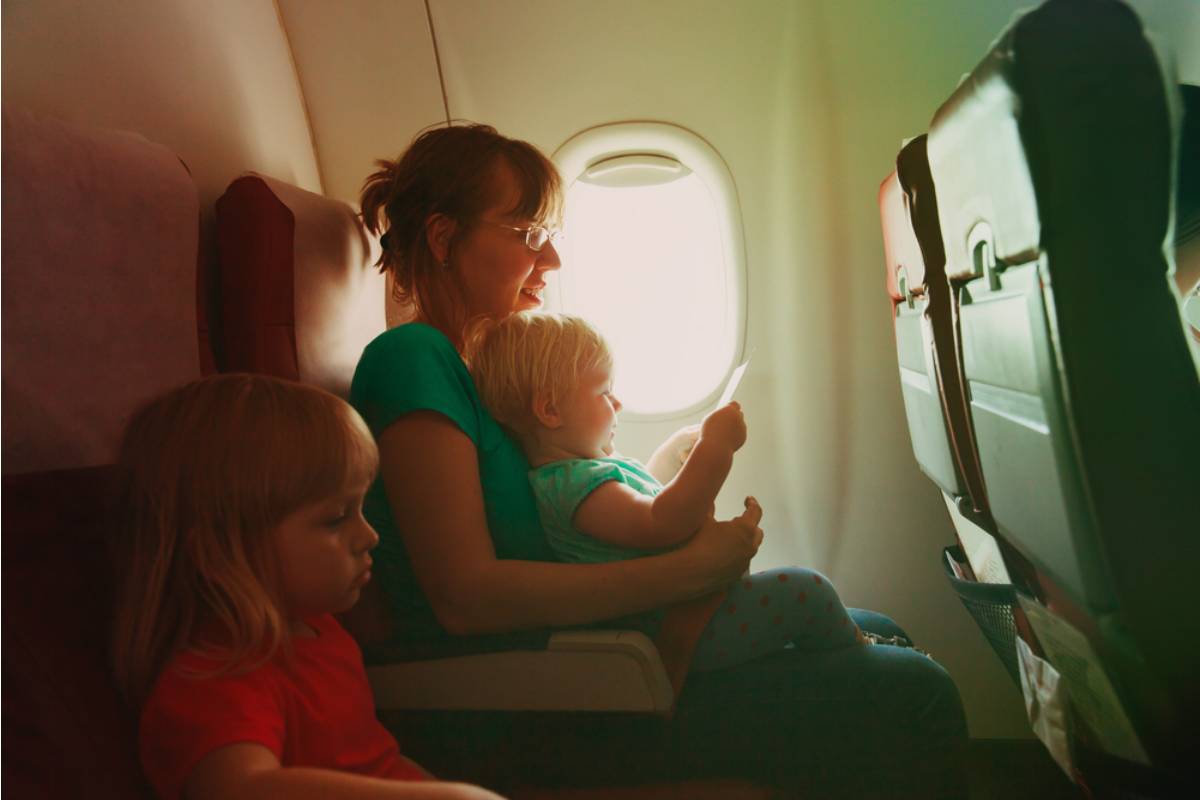
A Mom Says Her Husband Thinks Their 2- and 3-Year-Olds Will Watch Movies Through Their First Flight, and She Is Already Planning for Chaos

A mom shared her story while preparing for her family’s very first airplane trip with her two young children. The kids were now 2 and 3 years old, and their upcoming flight would last a little over two and a half hours. It was not an especially long journey on paper, but with two toddlers who had never even seen an airport before, she knew the day could become much more complicated.
Rather than gamble on everything going smoothly, she had spent the entire previous week preparing for every possibility she could imagine. She had snacks, toys, electronics, candy, reservations, parking plans, luggage, and the rest of the trip organized. By the time she finished preparing, she felt ready for almost anything the children could throw at her.
She Built an Entire Toddler Survival Kit
The mom carefully chose new snacks that her children had never tried before but that she believed they would enjoy. She also bought travel toys based specifically on each child’s current interests, including familiar shows and characters they already loved. The idea was to have something new enough to hold their attention but familiar enough to feel comforting.
Then came the backup plan for when the toys stopped working. She loaded the iPad with shows, movies, and games, creating another layer of entertainment in case the snacks and toys failed. Finally, she packed what she jokingly described as bribery candy, because sometimes parenting meant accepting that negotiations with a toddler required more than diplomacy.
Then She Asked Her Husband One Simple Question
After handling nearly every part of the preparation, she turned to her husband and asked whether he needed anything for the trip. He was normally a very involved parent, so she expected him to have at least a few ideas or concerns of his own. Instead, his answer left her staring at him.
He casually said that he assumed they would simply watch a movie for the entire flight. To the mom, that sounded like a plan created by someone who had never met a toddler. She could barely imagine getting a 2-year-old and a 3-year-old to sit quietly through one movie at home, let alone while traveling through an airport and flying for hours.
The Movie Idea Immediately Fell Apart in Her Head
The problem was not that the children disliked movies. The problem was their attention spans, their energy, and the fact that literally everything about the journey would be new. They would have to handle the airport, security, boarding, waiting, strangers, airplane noises, seat belts, takeoff, and landing before even settling down.
A response from a person pointed out that young children who are old enough to crawl, walk, and explore can be dramatically harder to manage on a flight than very young babies. Babies may sleep for long stretches, while toddlers are mobile enough to make their curiosity everyone else’s problem. The mom’s concern suddenly seemed much less dramatic when viewed from that perspective.
Parents Immediately Started Debating the Seating Plan
The first major piece of advice centered around where everyone should sit. One response from a person strongly recommended splitting the family into two pairs, with each parent sitting beside one child. The reasoning was simple: each adult would have a child to manage instead of one parent becoming trapped with both kids.
Another response from a person disagreed and preferred placing both children beside one parent while the other adult took the single seat across the aisle. That arrangement, they argued, could give the family more room to manage both children together and allow the adults to take turns getting a break. Almost immediately, the seating debate became its own reminder that family travel rarely has one magical formula.
The Parents Had Different Reasons for Picking Their Seats
One person explained that the two-and-two arrangement helped prevent fights over the window seat. It could also mean that if one child started kicking the seat in front, the sibling might be the one sitting there rather than an unsuspecting passenger. The parents could still stop the kicking, but at least the damage would stay within the family.
Another person pointed out that sitting three across with two kids can make it easier to handle both children without worrying about a stranger being directly beside them. The larger point seemed to be that parents should decide the arrangement based on their own children rather than assuming one seating pattern would work for everyone. In the end, the right configuration might not become obvious until the family actually tries it.
Someone Reminded Her That the Airport Might Be the Hard Part
The flight itself was not necessarily the biggest source of trouble. A response from a person recalled a family trip that turned into a nightmare after delays stretched into more than twenty-four hours. What was supposed to be a short direct flight became a combination of delays, rerouting, cancellation, and even more waiting.
During that ordeal, one parent said her 2-year-old stayed awake for sixteen hours while they were stuck in the airport. That story gave the original mom a reason to think beyond the scheduled two-and-a-half-hour flight. A perfect plan for the airplane would not matter much if the family first had to survive hours of delays with two restless toddlers.
Then the Diaper Disaster Stories Arrived
The next wave of responses focused on something nobody wants to think about until it happens. One person admitted that their children had created some memorable travel disasters involving vomiting, prompting them to recommend extra clothes for everyone, including the adults. Another person said plastic bags were among the most useful things they packed because they could handle everything from dirty clothing to food and trash.
A response from a person shared an especially unfortunate timing story after trying to change her toddler’s diaper shortly before boarding. Naturally, the child decided to poop while they were already heading down the jet bridge. The lesson was apparently that toddlers have impeccable timing when parents least want them to.
The Carry-On Suddenly Needed Its Own Survival Strategy
The discussion made one thing clear: parents should not think of the carry-on bag as just a place for snacks and electronics. It could become the family’s emergency supply closet for the entire day. Diapers, wipes, spare clothes, plastic bags, comfort items, snacks, and entertainment could all become important long before the plane landed.
Several people also emphasized bringing spare clothes for the adults. A toddler’s mess does not care who is sitting nearby, and an accident at the wrong moment can leave a parent stuck in uncomfortable clothing for hours. What had started as a two-and-a-half-hour flight was beginning to sound like an expedition where the luggage itself needed a contingency plan.
Some Parents Said Car Seats Changed Everything
Another response from a person suggested using car seats on the airplane for toddlers who are accustomed to them. The idea was that being securely strapped into a familiar seat could make the situation feel more like a long car ride. The children might still become restless, but they would not have unlimited freedom to climb around the cabin.
The suggestion also appealed because toddlers understand routines more easily when the surroundings resemble something they already know. A car seat could create a familiar boundary in a completely unfamiliar environment. It would not eliminate the chaos, but it could potentially make the expectations clearer for young children who were suddenly being asked to stay seated for hours.
Then Someone Mentioned Their Ears
Of course, there was another concern that had nothing to do with attention spans. A response from a person simply warned the mom to be prepared for the children’s ears during takeoff and landing. Other people suggested offering something to drink or using a pacifier during those parts of the flight.
For a parent planning the trip, even this became another little item to remember. The children might be distracted by the excitement one minute and uncomfortable the next. The mom was quickly discovering that traveling with toddlers involved preparing for several completely different problems that could appear one after another.
A Parent Who Had Flown With Toddlers Offered Reassurance
One response from a person described flying with a 3-year-old and an 8-year-old on a daytime flight. Surprisingly, the children did quite well because they were fascinated by looking out the window and watching movies. The return flight was actually worse because it was a red-eye and everyone was exhausted but unable to sleep comfortably.
That story gave the mom at least one reason not to assume disaster was guaranteed. Young children could surprise their parents in both directions. The same child who was impossible during one travel situation might suddenly become fascinated by airplanes, clouds, and a window seat the next time around.
Another Parent Said Babies Can Be Easier Than Toddlers
A response from a person who had traveled with a very young baby said the experience had gone surprisingly well. The baby had slept for a large portion of an international flight after being placed in a special bassinet. The parent later contrasted that experience with traveling once children became more mobile.
That comparison made the upcoming trip feel particularly relevant to the mom. Her children were not tiny babies who could simply sleep through the entire adventure. They were old enough to understand that something exciting was happening and energetic enough to object whenever they decided they had seen enough of it.
One Family Turned the Plane Into a Play Area
Another person shared a different strategy from a long international flight with a crawling baby. Their family had gotten bulkhead seats and brought a lightweight, foldable mat that gave the child a little space to play. The parent said the setup made the trip much easier than the regular seats they experienced on the return journey.
That story highlighted how much physical space can matter when traveling with young children. Parents cannot create a giant playroom at 35,000 feet, but even a small change in seating can sometimes give children more room to move. For the mom preparing for her first flight, the lesson was clear: every inch of usable space could suddenly feel precious.
Then Came the Advice About Giving Dad His Own Challenge
The seating conversation eventually produced a particularly blunt suggestion. One response from a person joked that the mom should sit across the aisle and let Dad deal with the chaos on his own. The idea was less about punishing him and more about making sure he experienced the full reality of traveling with two toddlers instead of quietly watching a movie himself.
That response struck at the heart of her original frustration. Her husband was normally involved, but his movie comment suggested that he might not yet understand how much preparation the trip required. Splitting the responsibility could make sure both parents were active participants rather than accidentally creating one parent in charge and one parent with headphones.
The Mom Was Doing More Than Packing Snacks
What bothered the mom was not necessarily that her husband had underestimated the children. It was that she had spent an entire week preparing for the reality while he seemed to assume the reality would simply behave itself. She had thought about entertainment, food, schedules, logistics, and emergencies while his plan could apparently be summarized in three words: watch a movie.
A response from a person pointed out that this kind of mismatch can make family travel feel very different for mothers and fathers. One parent may be mentally rehearsing every possible disaster while the other assumes everyone will simply adapt as they go. The problem becomes less about who is right and more about whether both adults are prepared to carry the workload once things stop going according to plan.
Then She Started Hearing the Worst-Case Stories
The more responses came in, the more wild the possible outcomes became. There were stories about sickness, delays, children refusing to sleep, toddlers needing to move constantly, and parents spending hours trapped in airports. Each story added another piece to the puzzle the mom had already been assembling.
Yet there were also stories of children behaving wonderfully, sleeping peacefully, and becoming fascinated with flying. The trip could go badly, smoothly, or somewhere in between. The mom could not predict which version of the experience her family would get, but she could at least make sure she was not boarding the plane with nothing but a movie and good intentions.
Three Hours Could Feel Very Different With Two Toddlers
On a normal day, two and a half hours was not an enormous amount of time. A family could drive somewhere, eat lunch, run errands, or watch a couple of shows without thinking much about it. Inside an airplane, however, those same minutes had to be broken into manageable pieces.
A snack might buy ten minutes. A toy might buy fifteen. A movie could buy forty minutes before someone suddenly needed something else. The entire strategy depended on having enough little distractions available that the children never had too much uninterrupted time to become bored.
The Unexpected Twist Was That Her Husband Might Learn Fast
The mom’s husband’s movie comment initially sounded like the biggest problem in the story. But the responses suggested that his lack of experience could be corrected very quickly once the trip actually began. After all, he was described as a very involved father, so it was possible that he simply had no idea what this particular stage of travel would demand.
The real surprise might come when he discovers that his carefully imagined quiet flight lasts approximately twelve minutes. At that point, the snacks, toys, iPad, candy, spare clothes, seating strategy, and emergency bags will suddenly make perfect sense. The family may still experience some chaos, but at least they will be going into it prepared for the fact that toddlers rarely follow the itinerary.
By the End, Nobody Really Expected a Peaceful Movie Marathon
The responses ultimately turned the mom’s simple rant into a complete lesson in traveling with toddlers. She had prepared for boredom, messes, delays, uncomfortable ears, arguments, and restless children because she understood that the trip was not just two and a half hours in the air. It was an entire travel day in which almost anything could happen.
Her husband’s movie idea was funny precisely because it represented the gap between imagining a trip and actually living through one with two toddlers. Maybe the children would surprise everyone and sit quietly for longer than expected. But if they did not, the mom would at least have snacks in one hand, toys in the other, a fully loaded tablet nearby, and a husband who had finally learned that the phrase “they’ll just watch a movie” is not much of a toddler travel strategy.