A Dad Says He Has Four More Days Alone With His Four Boys Before His Wife Returns, and His Definition of Success Has Changed Dramatically

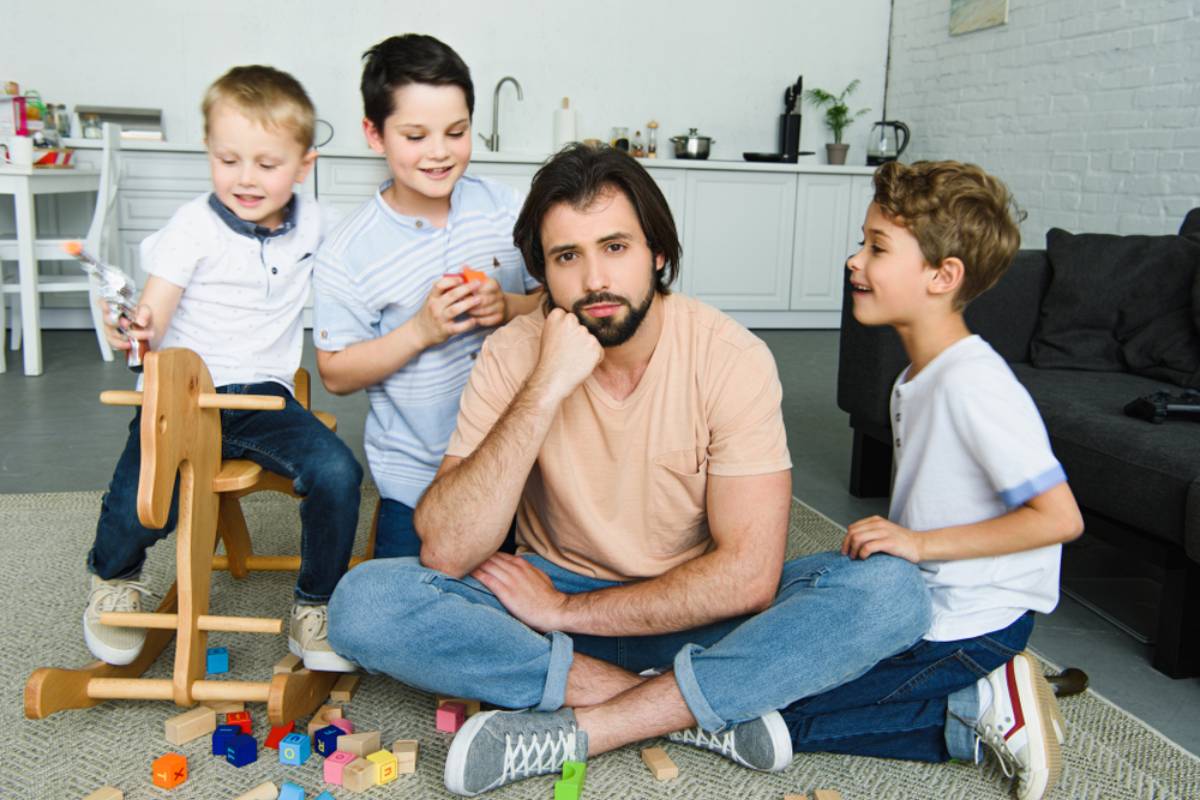
A father found himself on the seventh day of an eleven-day stretch as the only parent at home with his four boys, ages three, five, six, and nine. His wife was away on vacation with her sister, and he genuinely wanted her to enjoy the break because he loved her and knew she deserved the time away. However, after a full week of managing four energetic children and two dogs, he was discovering that loving his family and being completely exhausted could easily happen at the same time.
He decided to document the situation with a humorous account of life on the home front, describing the experience as a daily exercise in survival. The boys had mostly been in good spirits, and there had been no major disasters to report so far. Still, with four more days remaining, their father was beginning to measure success in a very different way than he had before the vacation started.
The Family Bed Had Become a Full House
The first unexpected development involved bedtime, when all four boys gradually decided that their mother’s absence meant they should sleep beside their father. The youngest was three, and the family usually allowed him to share the bed because otherwise he would wake everyone else in the house. Before long, what began as one child’s bedtime arrangement had turned into a full family sleepover.
One night, the father discovered that all four children and both dogs had somehow ended up in the same bed. He briefly considered escaping to the guest room, hoping to claim a little space for himself and enjoy a peaceful night’s sleep. Unfortunately, that plan required moving his CPAP machine, and the thought of completing one more task was apparently enough to defeat him completely.
The CPAP Machine Became the Final Obstacle
The father could handle four children climbing into his bed, two dogs claiming their share of the mattress, and the general chaos of parenting alone. Yet the simple administrative task of relocating his breathing equipment felt like an impossible mountain to climb. It was the perfect example of how exhaustion could make even a minor inconvenience feel like a major life event.
A response from a person pointed out that sometimes the biggest challenges were not the dramatic ones but the tiny additional steps that finally pushed an exhausted parent over the edge. Others understood why the father had given up on the guest room, especially when the alternative involved negotiating with children and pets for the remaining available sleeping space. At that point, surrendering to the crowded bed may have been the most sensible decision of the entire night.
Nine Minutes Without Music Caused a Morning Crisis
For most of the week, the children had been surprisingly cheerful, which their father considered a small victory. That peaceful pattern came to an abrupt end one morning when Spotify stopped working in the car. The boys had expected to enjoy the soundtrack from KPop Demon Hunters on their way to school, but instead they were forced to endure approximately nine minutes without their usual musical entertainment.
Their father described the experience as being left alone with their own thoughts, and apparently the silence was not well received. The incident offered a hilarious glimpse into how quickly a peaceful school run could turn into a crisis when a beloved routine suddenly disappeared. After seven days of solo parenting, he had discovered that a functioning music app could be nearly as important as breakfast.
A Dental Appointment Lost to a Safety Award
The father’s schedule also took an unexpected turn when he had to reschedule his five-year-old’s dentist appointment. The reason was that his six-year-old was receiving an award at school for being a role model of safety. The teacher had refused to reveal what the boy had done to earn the recognition because the announcement was supposed to remain a surprise.
That secrecy left the father to imagine increasingly ridiculous explanations for his son’s achievement. He jokingly suspected the boy might have independently contacted the city building inspector after deciding that a playground slide was too steep. Considering that the child was described as his most challenging son, the father found it difficult to believe that the award had come without an entertaining backstory.
The Family’s Reputation Was Suddenly Under Review
As he waited for the award ceremony, the father began questioning whether his son had actually done anything extraordinary. Perhaps the school had simply decided that someone in the family deserved recognition for understanding basic safety procedures. The suspicion came from an embarrassing incident a few weeks earlier, when the father had accidentally entered the school during a lockdown drill.
Finding the building unusually empty, he had loudly called out to ask where everyone was. The memory made him wonder whether his son’s award might somehow be a form of compensation for the family’s collective reputation. What was supposed to be a proud parenting moment had become another opportunity for him to question whether the adults in the household were setting the best possible example.
The Lockdown Drill Story Took an Unexpected Turn
A response from a person pointed out that the school should have had better procedures if a parent could casually walk inside during a lockdown drill. Other people were equally surprised that he had been able to enter a building when the purpose of the exercise was to secure its doors. The discussion quickly expanded as people shared their own experiences of arriving at schools during drills or actual lockdowns without realizing what was happening.
One person recalled attempting to drop off a child during an actual lockdown that fortunately turned out to be a false alarm, only to discover that the student could not enter the building. Another response came from the father himself, who revealed that he had worked as a security guard during college. In a particularly ironic twist, he once reported an incident that triggered a lockdown and then found himself locked outside near the scene of a stabbing.
The Nine-Year-Old Had Earned a New Responsibility
While the school situation provided plenty of material for jokes, the father had also found a practical way to make everyday life more manageable. For three days, he had delegated the responsibility of preparing his three-year-old’s daycare lunch to his nine-year-old son. On the first day, he carefully inspected the lunchbox and found a sandwich, fruit, a snack, and water.
Everything appeared balanced enough for a normal daycare lunch, so the oldest boy earned an imaginary promotion. His father decided that the young assistant was capable of handling the task with less supervision. It was a small adjustment, but with four children demanding attention every day, handing over a responsibility could make a meaningful difference.
The Lunchbox Inspection Policy Quietly Disappeared
On the second and third days, the father changed his approach and simply asked whether the lunch had been prepared. His oldest son said yes, and the father accepted the answer without conducting another detailed inspection. No complaints had arrived from daycare, and the youngest child had not returned home unusually hungry, so the father took those developments as evidence that the arrangement was working.
The only problem was that he had absolutely no idea what had been packed into the lunchbox during those two days. He imagined that his son might have sent his little brother off with two doughnuts covered in shortening, a handful of crackers, and three postage stamps. Since nobody had contacted him to complain, he had decided that the system was functioning well enough to survive another day.
The Father Embraced a New Definition of Delegation
A response from a person praised the father for recognizing that delegation was part of the parenting process, especially when one adult was responsible for an entire household. Other people were amused by the fact that a lack of complaints had become the only quality-control measure he needed. The situation captured the funny reality of exhausted parenting, where a task that would normally receive careful attention could become a simple matter of trusting another family member.
The father did not pretend that the lunch arrangement was perfect, and that honesty made the story all the more entertaining. He knew the contents could have been questionable, but he also knew that children sometimes learned responsibility by being given a genuine job to do. At that point, the mystery lunchbox had become a symbol of his larger strategy: trust the process, keep the children fed, and avoid creating extra work unless absolutely necessary.
The Internet Wondered How He Was Managing Four Boys
After reading the father’s account, people began questioning how anyone could manage four young boys alone for eleven days without losing their mind. One response jokingly suggested that at least two possibilities had to be true: the children were exceptionally wonderful, or the father possessed extraordinary abilities. Others proposed less flattering explanations, including the possibility that he was exaggerating the story.
Another person who was parenting four girls said the account was a joy to read and congratulated him on handling the challenge. The father explained that he had studied creative writing many years earlier, which might have helped him turn ordinary household chaos into such an entertaining story. Readers appreciated that he could describe exhaustion without making the children sound like villains or pretending that every moment of family life was miserable.
Four More Days Became the Final Countdown
By the seventh day, the father had stopped expecting perfection and adopted a much simpler objective. He wanted to return his wife to the same number of children she had left behind, with everyone in roughly the same condition. He made no promises about hair, fingernails, balanced nutrition, or whether the boys would still be willing to sleep in their own beds.
His standards were both hilarious and surprisingly practical. As long as all four boys remained alive, loved, and capable of explaining what had happened during the eleven days, he considered the mission achievable. He felt reasonably confident about the dogs as well, although he was much less certain about the state in which his wife would find him when she returned.
The Neighborhood Offered an Unexpected Backup Plan
One response joked that the father might be allowed some flexibility as long as his wife returned to the same number of children, even if the exact arrangement had changed. The father took the idea in stride, explaining that there were around fifteen children on his street. As long as four children of approximately the correct ages were available for inspection, he joked that he might still qualify for a trophy.
The exchange also revealed how easily children could move between neighborhood homes without adults always knowing where they had gone. The father admitted that his first instinct when encountering a child in his house was often to ask whether the child was hungry. He had recently realized that asking whether the child’s parents knew where they were should probably come first.
The Stories From Other Families Made the Chaos Feel Familiar
As people continued responding, the discussion became a collection of parenting stories about unexpected children, school emergencies, and the strange situations families found themselves navigating. One person shared a story about returning home late at night and discovering an unfamiliar teenage boy asleep in a living-room recliner. When she asked who he was, he explained that his grandmother had kicked him out and that her daughter had offered him a temporary place to stay.
Rather than immediately sending him away, the mother allowed the teenager to remain in the home for several days while making sure his family was contacted. The story offered a softer counterpoint to the father’s jokes about survival, showing how family life could include moments of compassion alongside exhausting logistical challenges. It also reminded readers that children and teenagers sometimes needed adults willing to offer a safe place, a meal, or simply someone prepared to listen.
The Final Four Days Were About More Than Survival
One response offered the father some practical advice for his wife’s return, suggesting that he should resist the temptation to immediately hand over all four children the moment she walked through the door. Instead, he could give her time to settle in, reconnect with the boys, and recover from traveling while he handled dinner and the household responsibilities for a little longer. After managing the family alone for eleven days, that extra effort could make the end of her vacation feel less abrupt.
Other people encouraged him to keep going, pointing out that the experience would likely become one of those family stories everyone remembered for years. One response came from a widowed parent who had raised three children from infancy into adulthood and reassured him that he was doing well. The father replied warmly, appreciating the encouragement and sending love to the other family.
With four days left, he still had the crowded bed, questionable lunchboxes, school schedules, and unpredictable mornings to contend with. Yet his story had become more than a funny account of one exhausted dad trying to keep everything together. It was also a reminder that a parent did not need to manage every detail perfectly to give children a home filled with care, safety, and memorable moments.