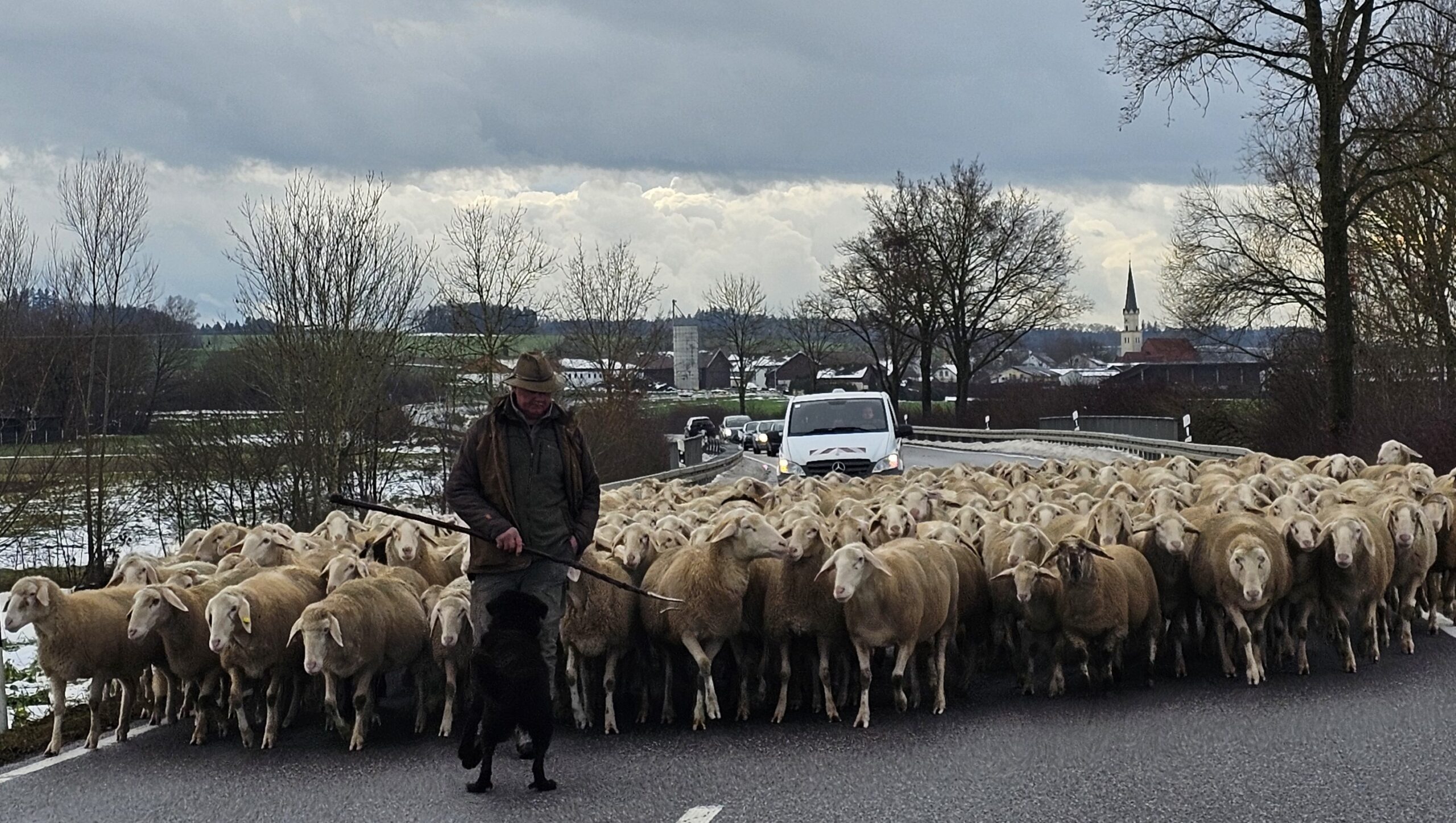
A Teacher Asked Eighth Graders How Old a Shepherd Is if He Has 125 Sheep and 5 Dogs. About 75% Gave a Number.

Of 32 eighth graders asked, “There are 125 sheep and 5 dogs in a flock. How old is the shepherd?” 24 gave a number. That is 75%, well above the 50% their teacher, Robert Kaplinsky, had predicted, and 12 of the students said 25. The question has no answer, and the experiment Kaplinsky recorded in 2013 is making the rounds again after Upworthy revisited it on Nov. 12, 2026.
Kaplinsky, a longtime math educator, interviewed each student one at a time and recorded the conversations on video, according to his blog post of Dec. 1, 2013. The post does not name the school or class.
The Question and the 24 Numbers
Before the interviews, Kaplinsky guessed that about half of the students would try to compute an answer. Instead, 24 of the 32 did. Twelve divided 125 by 5 and answered 25. Two added the numbers for 130, and two subtracted them for 120. Nobody multiplied to get 625. Upworthy adds that in an earlier essay by education professor Katherine Merseth, 25 was the most common answer because 120 and 130 seemed too old for a shepherd.
Four students said they were guessing, offering 90, 5, 42 and 50. Four more tried to divide 125 by 5 but could not carry out the division correctly. The other eight did not give a number.
One student used a trick of adding the sheep and dogs and dividing by two, which produced 65. Another divided because the problem never said “sum,” “difference” or “product,” so division seemed like the only operation left.
The Student Who Got 120 and Guessed 90
The detail that made the post spread is a student who first answered 120, then stopped and said the problem did not give enough information to find the shepherd’s age. Upworthy reported that the same student guessed 90 anyway, because the student felt uncomfortable not giving an answer.
Kaplinsky wrote that many students seemed to sense the question was odd but felt they could not question the person asking it, and that they felt obligated to answer. He credited a commenter named Cari Noble with the term “intellectual autonomy” for the missing skill: thinking independently instead of depending on others for direction.
Why Students Answer an Unanswerable Question
The pattern was documented long before Kaplinsky’s interviews. His post notes that Katherine Merseth’s 1993 essay, based on research by Kurt Reusser in 1986, reported that three in four schoolchildren give a numerical answer, and he wrote that it was still true twenty years later. A 2005 news page from the Harvard Graduate School of Education describes Merseth as a senior lecturer there and cites her essay “How Old Is the Shepherd?” in a discussion of math misconceptions. The page says students are often held back by fear of a wrong answer and the belief that math has only one answer and one method. Upworthy’s summary of the essay says students often treat math as a set of memorized procedures and rush to compute before they understand the situation, which fits what the shepherd question exposes. The same page quotes Merseth saying children “make up their own rules and procedures” and that their answers are not random, because there is a reason behind them.
Sally Jordan of the Open University, writing on her university blog, says many schoolchildren still try to produce an answer and often arrive at 25. Students who gave 25 reasoned that only two numbers were available and that division was the only operation that produced a believable age. One student, Jordan notes, said a teacher would not hand out a problem with no solution, which she finds troubling because it suggests trial and error with formulas rather than real problem solving.
What a Munich Study Found About Classroom Context
A 2018 paper in the proceedings of the British Society for Research into Learning Mathematics, by Natalia Molina, Anselm Strohmaier and Kristina Reiss of the Technical University of Munich, studied “age of the captain” problems with 48 third and fourth graders in two bilingual classes at an international school in Berlin. The authors trace this type of nonsense word problem to a 1980 study by the IREM institute in Grenoble. A typical example asks how old a ship’s captain is when there are 20 sheep and 6 goats aboard.
On average, students in the math class gave arithmetic answers to 2.87 of five items, about 57%, and students in the language class gave 2.33, about 47%. The difference was not statistically significant. Students in both classes felt a conflict between the expectation to give a number and the sense that the problem made no sense. Interviews suggested the math class encouraged numerical answers, while the language class encouraged rereading and questioning the problem. The authors concluded that classroom context shapes how students respond.
Kaplinsky’s conference handout uses the shepherd problem to argue for performance tasks that reveal whether students make sense of a situation or only compute with the numbers on the page. His blog post ties the exercise to the first of the Common Core mathematical practices, which stresses making sense of problems and checking whether an answer is reasonable.
The sample is small: 32 students interviewed in one project, with no school named. The larger point comes from the long line of studies, from Reusser and Merseth to the Munich team, that keep finding the same habit across ages and countries.
Get stories like this by email. Sign up for The Parent Diaries Letter.
This article was produced with AI assistance and edited for accuracy against the sources linked above.
Image: Runologe – CC BY-SA 4.0/Wikimedia Commons