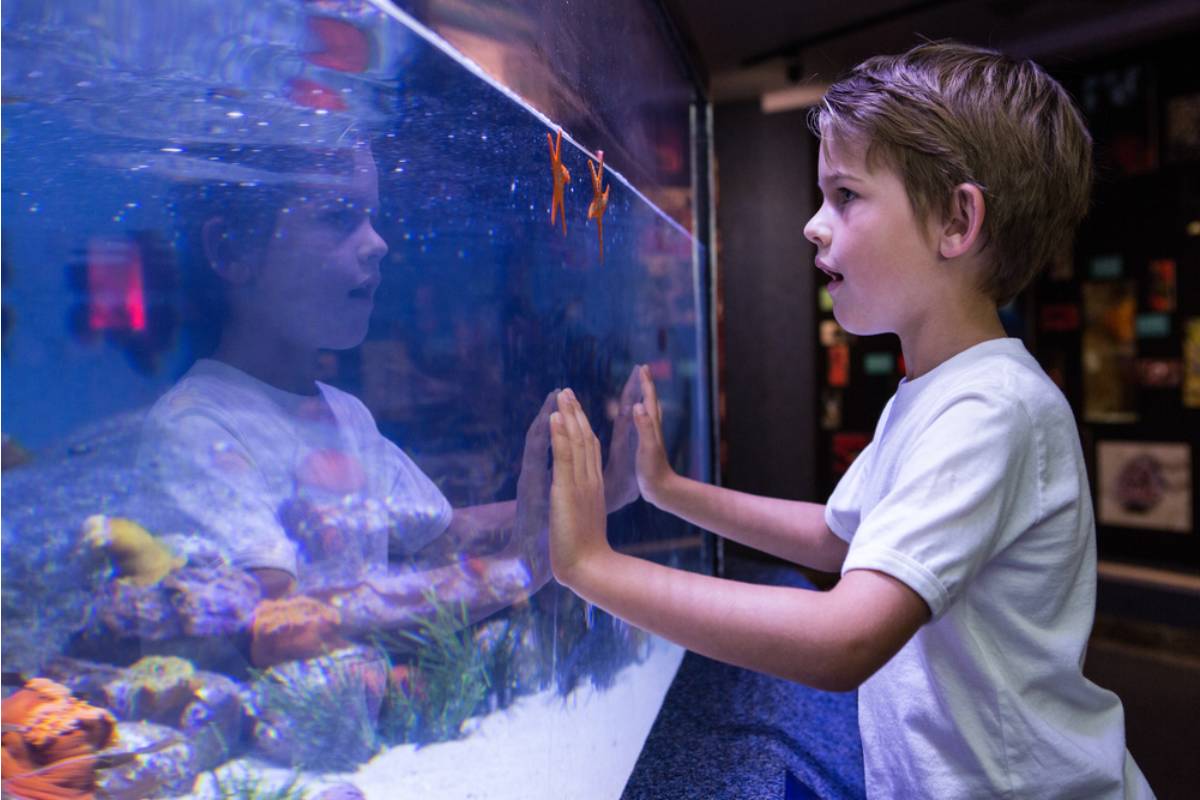
A Teacher Says a Student Told Her the Class Fish Tank Is the Quietest Corner of the Room and He’s Started Doing His Work There Instead of His Desk

Mrs. Parker first noticed something unusual when she realized one of her students had stopped sitting at his desk during independent work. Eleven-year-old Caleb had begun carrying his notebook to the corner where the class fish tank sat, completing his assignments beside the quiet hum of the filter. When she asked him why, his answer made her look at the classroom differently.
The Empty Desk
The first time Mrs. Parker noticed Caleb’s empty chair, she assumed he had gone to sharpen a pencil. She continued helping another student until she realized Caleb had been gone for several minutes.
Then she spotted him across the room, sitting on the floor beside the fish tank with his workbook open across his knees. He was writing carefully while watching a bright orange fish circle a plastic castle.
The Question That Caught Her Off Guard
Mrs. Parker walked over and crouched beside him. “Caleb, what are you doing over here?”
Caleb didn’t look embarrassed. He simply pointed toward his desk and said, “It’s too loud over there.” Mrs. Parker glanced toward the classroom, where students were whispering, chairs were scraping against the floor, and pencils were tapping against desks.
The Fish Tank Becomes His Office
Caleb explained that he had discovered the corner during a previous reading period. The filter made a soft humming sound that covered the little noises happening around the classroom.
“Nobody bothers me here,” he said. “I can actually think.” Mrs. Parker asked whether he was able to see the board from the corner, and Caleb shook his head, saying he only moved there after instructions had been given.
A Habit Nobody Had Reported
Mrs. Parker asked the other students whether Caleb had been working beside the fish tank regularly. Several children nodded.
One girl said, “He does it almost every day.” Another student laughed and said, “He likes the fish more than us.” Caleb smiled but didn’t respond.
The Notebook Filled With Fish
During lunch, Mrs. Parker looked through Caleb’s recent assignments. His work was noticeably neater on the days he had worked beside the tank.
She also noticed tiny drawings of fish in the margins. They weren’t elaborate, but there were dozens of them, each one labeled with names like Rocket, Blue, and Captain.
Caleb Explains the Names
Mrs. Parker asked him about the drawings after lunch. Caleb explained that he had named every fish in the tank.
The orange fish was Captain. The smaller silver one was Rocket. The black fish was Shadow, even though Caleb admitted Shadow wasn’t actually black.
Mrs. Parker smiled and asked whether he liked watching them.
“Yeah,” Caleb said. “They don’t talk.”
The Real Reason He Moved
Mrs. Parker gently asked whether the noise at his desk made it difficult to concentrate.
Caleb nodded. Then he admitted something he hadn’t told anyone. “Sometimes when everybody is talking, I can’t figure out which voice I’m supposed to listen to.”
Mrs. Parker realized this wasn’t about the fish at all.
The Group Assignment Goes Wrong
The following week, Mrs. Parker assigned a small group project. Caleb’s group gathered around a table near the center of the classroom.
At first, everything went well. Then two students started talking over each other while another began tapping a pencil against a notebook. Caleb became increasingly quiet until he eventually picked up his papers and walked toward the fish tank.
The Teacher Follows Him
Mrs. Parker followed Caleb and found him sitting beside the tank again.
“You don’t want to work with your group?” she asked. Caleb shook his head quickly.
“I do,” he said. I just can’t hear what they’re saying when everyone talks at once.
That answer changed the conversation.
A Different Seating Arrangement
Mrs. Parker moved Caleb and his group to a quieter table near the side of the classroom. She told the students they could still collaborate, but only one person should speak at a time.
Caleb returned to the group without complaining.
For the first time, Mrs. Parker noticed him speaking more than he had during previous group assignments.
The Fish Tank Gets Crowded
A few days later, Mrs. Parker found three students sitting beside the fish tank during independent work.
She asked what was going on.
One student said, “Caleb says it’s the quietest place.”
Caleb looked embarrassed.
Mrs. Parker told them they could use the corner as long as they continued working and didn’t crowd the tank.
The Quiet Corner Becomes Popular
Within a week, students started asking whether they could work beside the fish.
Mrs. Parker worried that the area would become a distraction, but something unexpected happened. Students who normally struggled to settle down were often quieter when they sat there.
The fish tank had become a natural calming spot.
The Principal Walks In
One afternoon, the principal, Mr. Reynolds, entered the classroom during independent work. He stopped when he saw Caleb sitting beside the fish tank with three other students.
He asked Mrs. Parker what was happening.
Mrs. Parker explained that Caleb had discovered the corner because he found the classroom noise distracting.
Mr. Reynolds looked at Caleb and asked, “Does it help?”
Caleb nodded.
Caleb Says Something Honest
Mr. Reynolds pulled up a chair and asked Caleb why the fish tank worked better than his desk.
Caleb thought for a moment.
“Because everything has a sound, but none of it is loud,” he said.
Mr. Reynolds looked at Mrs. Parker.
Neither of them expected that answer.
The Parent Conference
Mrs. Parker later mentioned the situation to Caleb’s mother, Julia, during a parent conference.
Julia laughed at first and said, “He has always hated crowded restaurants.”
Then she became thoughtful.
She told Mrs. Parker that Caleb often completed homework at the far end of the kitchen while everyone else was talking.
“I thought he just liked being alone,” Julia said.
Mrs. Parker replied, “He might just like being able to hear himself think.”
A Small Experiment
Mrs. Parker decided to test whether the environment was affecting Caleb’s work.
For one assignment, she let him choose between his regular desk, the side table, and the fish tank corner.
Caleb immediately chose the side table.
When Mrs. Parker asked why, he said, “The fish corner is good when I need really quiet, but the side table lets me still hear you.”
The Teacher Changes Her Classroom
Mrs. Parker began creating several quieter work options around the classroom.
Students could choose a desk near the wall, the side table, or the fish tank area.
She also introduced short periods where everyone worked silently.
The room didn’t become completely quiet, but it became more predictable.
Caleb Starts Helping Others
One afternoon, a younger student from another class visited to read with Caleb’s group.
The boy became nervous when the classroom grew noisy.
Caleb quietly pointed toward the fish tank and said, “You can sit over there if you want.”
Mrs. Parker watched the boy move to the corner.
He immediately relaxed.
The Fish Tank’s New Purpose
Mrs. Parker eventually put a small sign beside the tank that read, “Quiet Work Corner.”
It wasn’t meant to be a punishment area or a place where students were sent when they misbehaved.
It was simply another option for students who worked better with fewer distractions.
Caleb’s Desk Changes
A few weeks later, Mrs. Parker noticed Caleb had started decorating the corner of his desk with small fish stickers.
She asked whether he still needed the tank.
“Sometimes,” Caleb said.
Then he added, “But I don’t have to go there every time anymore.”
Mrs. Parker smiled.
The Day the Filter Stopped
One morning, the fish tank filter stopped working.
The classroom suddenly felt strangely different.
Caleb noticed immediately.
“It sounds weird without it,” he said.
Mrs. Parker restarted the filter, and the familiar hum returned.
Caleb laughed and said, “There. Now I can think.”
A Conversation About Noise
Mrs. Parker used the moment to ask the class whether different sounds affected them differently.
Several students admitted they struggled with noise during independent work.
One student said pencil tapping drove him crazy.
Another said whispering was worse than talking because he kept trying to figure out what people were saying.
Mrs. Parker realized Caleb wasn’t the only one who had been quietly adjusting to the classroom.
The New Rule
The class agreed on a simple rule: during independent work, students would keep conversations low and avoid unnecessary noises.
The rule wasn’t perfect.
Someone still dropped a pencil almost every day, and somebody always whispered at the wrong moment.
But the room became easier for everyone to manage.
Caleb’s Last Trip to the Corner
Near the end of the semester, Caleb carried his notebook toward the fish tank.
Mrs. Parker watched him sit down and begin working.
After a few minutes, he looked over at her and said, “I think this is still my favorite place.”
Mrs. Parker asked why.
Caleb looked at the fish circling the castle and smiled.
Because nobody expects anything from them,” he said. “They just swim around.”
What the Teacher Finally Understood
Mrs. Parker had initially thought Caleb was wandering away from his desk because he was distracted.
Instead, he had found the one place in the classroom where he could concentrate without fighting through every sound around him.
The fish tank hadn’t solved his problems, and Caleb didn’t need to spend every assignment sitting beside it. What changed was that his teacher finally understood that giving a student a quieter way to work wasn’t giving him an advantage.
It was giving him a fair chance to show what he already knew.