Children’s Mercy Kansas City Will Keep Kids Under 13 Off Its Inpatient Units Starting Nov. 10 as RSV and Flu Season Builds

Tuesday, Nov. 10, is the day the youngest visitors lose their place at the bedside at Children’s Mercy Kansas City. From that date, children 12 and under, which means every child under 13, will not be allowed on the hospital’s inpatient units, a rule the hospital says is tied to respiratory virus season, which includes RSV, flu and COVID-19.
The rule was announced in an Oct. 22 post on the hospital’s Parent-ish blog by pediatric infectious disease physicians Dr. Edward R. Lyon and Dr. Christelle M. Ilboudo. The hospital’s visitor pages, updated Nov. 6, spell out who is affected and who is not.
Who Can and Cannot Come Up to the Inpatient Floors
According to the hospital’s visitor guidelines, children 12 and under “will not be able to visit patients in the hospital” once the viral season rules begin. Visitors ages 13 to 16 may come, but they must always be with an adult. All visitors must feel well and be free of illness.
Parents and guardians are treated differently. The hospital’s visiting hours page says they are part of the care team rather than visitors, and they may be with their child around the clock. They receive a green wristband, must sign in and have to follow all safety precautions. Up to two parents, guardians or authorized adults may stay overnight in the patient’s room.
Other guests may visit from 9 a.m. to 9 p.m. Visitors 16 and older need a driver’s license or other photo ID and must wear the sticker they are given. The page notes that exceptions are sometimes possible and tells families to ask their child’s nurse.
The restrictions do not apply to clinic or outpatient visits. A family whose child is admitted after a clinic or emergency room visit does face a practical problem, though. According to the hospital, brothers and sisters 12 and under who came along cannot go up to the inpatient unit, so families are told to plan for another caregiver for those children.
Why the Cutoff Falls at Age 12
Children’s Mercy says the reasoning is about both risk and habits. The hospital’s visiting hours page states that children 12 and under are the most likely to catch these viruses and the least likely to follow the habits that stop them from spreading. The Parent-ish post puts it more briefly: children 12 and under are the most at risk of catching a virus.
Ilboudo is quoted on the visitor guidelines page making the broader point: “Anyone who has a respiratory virus can give it to someone else.” The hospital says the rules protect sick children, their families and staff.
The post describes how the viruses move. RSV spreads through respiratory droplets or when a person touches a contaminated surface and then touches the face. Influenza also travels in droplets and, the doctors write, can last at least a week and can be deadly, so it should not be dismissed as “not that bad.” The hospital’s visitor pages add that the policy can change during periods of high infection risk.
The timing lines up with the calendar. The CDC says on its RSV page that RSV spreads in fall and winter and usually peaks in December and January.
What the CDC and Children’s Mercy Say About RSV and Flu in Young Children
The Children’s Mercy doctors write that RSV is the leading cause of infant hospitalization in the U.S., and that most hospitalized infants had no chronic medical problems. The American Academy of Pediatrics makes a similar point on its RSV campaign page, calling RSV the most common cause of hospitalization in children under age 1.
For most healthy children RSV looks like a cold. The Parent-ish post says it usually clears in one to two weeks but can cause bronchiolitis and pneumonia in infants under 6 months and in children with weakened immune systems. The CDC’s page on RSV symptoms says very young infants may show only irritability, decreased activity and breathing difficulties. Symptoms usually appear four to six days after infection and tend to develop in stages. The CDC advises calling a health care professional if a child has difficulty breathing, is not drinking enough fluids or is getting worse, and it says aspirin should not be given to children.
Flu carries its own numbers. The CDC’s page on flu in children estimates 6,000 to 25,000 flu-related hospitalizations a year among children under 5. Annual vaccination is recommended for everyone 6 months and older, and children 6 months through 8 years need two doses if it is their first vaccination, if they have had only one previous dose or if their history is unknown. The second dose comes at least four weeks after the first. The Children’s Mercy doctors say not to delay the flu shot while waiting for a particular type.
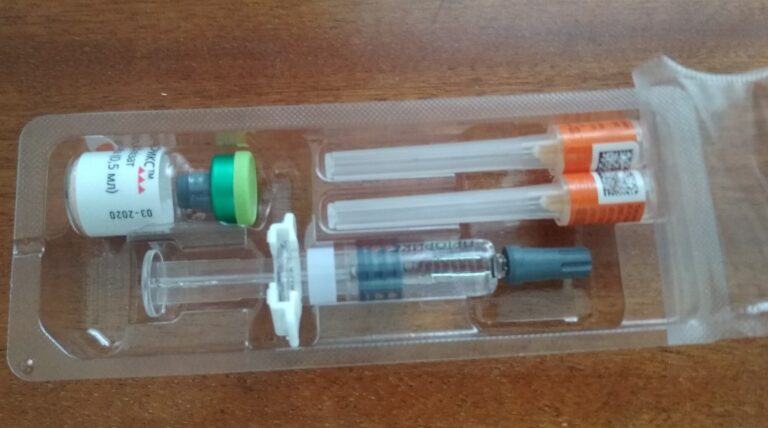
For babies, the post lists two one-time antibody injections that are not vaccines: nirsevimab (Beyfortus) for infants entering their first RSV season, and clesrovimab (Enflonsia) for infants under 1. It also names Abrysvo, an RSV vaccine given during pregnancy so mothers pass antibodies to the baby. Parents are told to ask their child’s doctor about eligibility. An earlier Parent Diaries report on RSV in babies under 6 months covers how symptoms tend to progress.
The CDC’s list of flu emergency warning signs for children includes fast or difficult breathing, bluish lips or face, ribs pulling inward with each breath, dehydration, a child who is not alert, seizures and a fever above 104 degrees that does not respond to medicine. It also lists any fever in a child younger than 12 weeks.
Get stories like this by email. Sign up for The Parent Diaries Letter.
This article was produced with AI assistance and edited for accuracy against the sources linked above.
Image: ShawnCMH – CC0/Wikimedia Commons