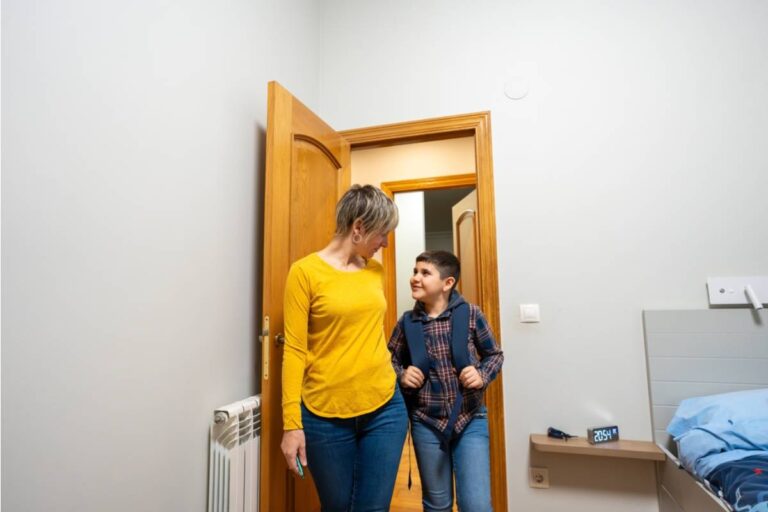
A Teacher Says a Student Told Her He Started Keeping His Backpack Packed by the Door “Just in Case Plans Change Again”

Children sometimes reveal the hardest parts of their lives without realizing how much they have shared. One teacher thought she was asking a routine question about organization, but a student’s answer hinted at a home life built around uncertainty instead of stability. The conversation that followed became something she could not stop thinking about long after the school day ended.
A Simple Compliment Opened the Conversation
Mrs. Bennett had spent the first few minutes of class praising students who had remembered all their materials for a group science project. Sixth grader Mason was one of the few who always seemed completely prepared.
His notebooks were organized, his pencils were sharpened, and his assignments were never missing. Even students who forgot something almost every day joked that Mason could probably survive a month with whatever was inside his backpack.
Smiling, Mrs. Bennett said, “You are always ready for anything.”
Mason answered with a small shrug.
An Answer That Changed Everything
Without looking up, Mason quietly replied, “I keep it packed by the front door every night.”
Mrs. Bennett smiled.
“That’s a great habit.”
Mason nodded once before adding, “Just in case plans change again.”
The sentence sounded so casual that another student barely noticed it.
Mrs. Bennett did.
The Words Stayed in Her Mind
Class continued, but Mrs. Bennett found herself replaying Mason’s comment.
Children often developed routines because parents encouraged them.
This felt different.
There had been something careful about the way he spoke, almost as if he were describing a rule that existed because experience had taught him not to expect tomorrow to look like today.
She decided not to press him in front of everyone else.
A Quiet Conversation After the Bell
When dismissal arrived, Mrs. Bennett asked Mason if he had a minute to help straighten the classroom.
He happily stacked a few books and pushed chairs into place.
Once the room was empty, she gently asked, “What did you mean when you said plans change again?”
Mason hesitated before answering.
“It just happens a lot.”
The Routine No Child Should Have
Mrs. Bennett waited patiently.
Finally Mason explained.
“Sometimes I stay at Mom’s house.”
“Sometimes Dad picks me up.”
“Sometimes Grandma comes because one of them has to work late.”
He smiled politely, almost apologetically.
“So I keep everything ready.”
More Than Just Forgotten Schedules
Mrs. Bennett assumed he was talking about normal shared custody arrangements.
Then Mason continued.
“Sometimes nobody tells me until I’m already at school.”
He laughed awkwardly.
I’ve gone home on the wrong bus before because I thought I was sleeping at Mom’s.
His laugh disappeared as quickly as it came.
“So now I pack for everything.”
Looking More Closely
Over the next several days, Mrs. Bennett noticed details she had overlooked before.
Mason never decorated his desk with personal items like the other students.
He carried extra clothes in his backpack even when nobody else did.
His permission slips were always signed at the very last minute because he never seemed certain which parent would see them first.
Everything about him reflected preparation instead of comfort.
A Missed Field Trip Form
The following week the class prepared for a science museum field trip.
Every student had returned the required permission form except Mason.
Mrs. Bennett quietly reminded him before lunch.
He looked embarrassed.
“I don’t know whose house it’s at.”
Mrs. Bennett frowned.
“What do you mean?”
I left it on Dad’s kitchen counter.”
“But I stayed at Mom’s yesterday.”
Reaching Out to Home
Mrs. Bennett contacted both parents separately.
She quickly discovered there had been no arguments or emergencies.
Instead, both parents were trying their best while juggling demanding jobs, changing work schedules, and shared custody.
Each believed the other had communicated changes to Mason.
Neither realized how often he was piecing together plans by himself.
The Meeting Nobody Wanted
A conference was scheduled after school.
Mason’s mother arrived first carrying a planner filled with work appointments.
His father rushed in several minutes later still wearing his construction boots.
Both immediately apologized for being late.
Mrs. Bennett noticed something important.
They cared deeply about Mason.
They simply had no idea how much uncertainty he was quietly managing.
Hearing Mason’s Own Words
Rather than criticize either parent, Mrs. Bennett repeated exactly what Mason had told her.
“He keeps his backpack packed by the door because plans might change.”
The room became silent.
His mother covered her mouth.
His father slowly leaned back in his chair.
Neither had realized their son viewed flexibility as something he had to prepare for every single day.
A Better System Began to Form
Instead of arguing about the past, the three adults focused on practical solutions.
They created one shared digital calendar that everyone could access.
Transportation plans would now be finalized the evening before whenever possible.
If changes became unavoidable, Mason would receive a text message before school instead of trying to guess throughout the day.
Small changes suddenly seemed very important.
Mason Noticed Before Anyone Said Anything
Within two weeks, Mrs. Bennett saw a difference.
Mason stopped asking classmates which bus they were taking.
He no longer checked his phone anxiously during dismissal.
One afternoon he even left his extra duffel bag at home because he knew exactly where he would be sleeping that night.
For most children, those details would have seemed ordinary.
For Mason, they felt unfamiliar.
An Assignment Revealed the Real Impact
Later that month students were asked to write about a place where they felt most relaxed.
Many described beaches, grandparents’ houses, or camping trips.
Mason wrote about his own bedroom.
Not because it was fancy or filled with toys.
He explained that he liked knowing where everything would be when he woke up the next morning.
Mrs. Bennett quietly reread that sentence several times.
A Different Backpack by the End of the Year
On the final week of school, Mrs. Bennett noticed Mason walking toward dismissal carrying a noticeably lighter backpack.
She smiled.
“Forget something today?”
He laughed.
“No.”
“So what changed?”
Mason adjusted the straps.
“I don’t have to carry everything anymore.”
She knew he was talking about more than notebooks and spare clothes.
As students poured into the hallway, Mrs. Bennett watched Mason leave with an easy confidence she had not seen before. His backpack no longer represented constant preparation for unexpected changes. It had become what every child’s backpack should be, a simple bag filled with school supplies instead of silent worries.
The experience reminded her that children often adapt so well to instability that adults mistake survival skills for maturity. Sometimes the most responsible child in the classroom is simply the one who has learned that life can change without warning, and that lesson is far heavier than anything they carry on their shoulders.