A Mom of Five Says People Treat Big Families Like They’re Doing Something Wrong, and She’s Tired of Hearing Her Kids Are “Too Many”

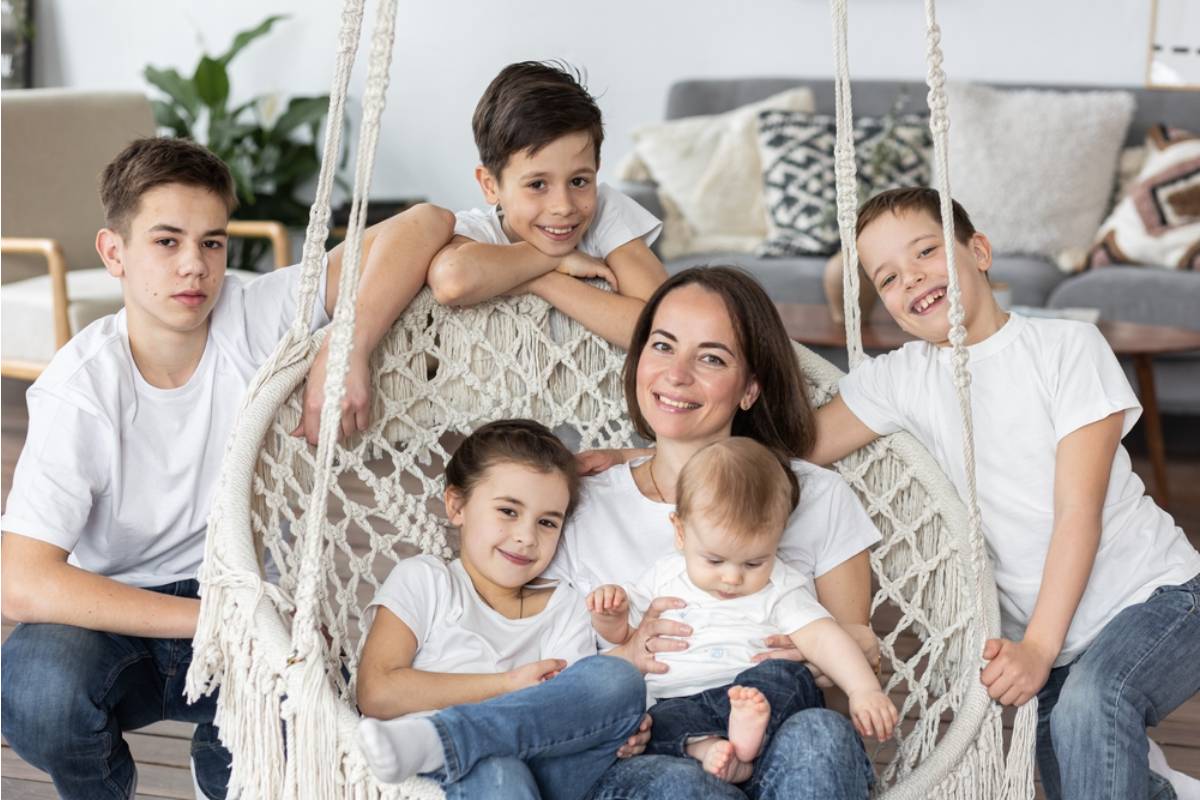
A person shared his story about raising a family of seven and becoming increasingly frustrated by the way larger families are sometimes discussed. She is a mom of five, with children ranging from 5 to 16, and she described their home as chaotic in the best possible way. To her, having seven people under one roof wasn’t a problem to solve but a life she genuinely loved.
What bothered her was seeing conversations where families with three or more children seemed to be portrayed as somehow less ideal. She felt that some people treated smaller families as objectively better because parents could supposedly provide more money, more attention, and a calmer childhood. Her own experience didn’t match that picture at all, and she wanted people to understand that a noisy house could still be an incredibly happy one.
Five Kids Made Her House Feel Full of Life
The mom described her family as a household of seven, which naturally meant there was rarely much silence. Her children were 16, 14, 11, 8, and 5, so they were at completely different stages of childhood. There were teenagers, school-age kids, and a young child all sharing the same home and creating their own little ecosystem.
Instead of seeing that as exhausting or undesirable, she saw it as one of the best parts of family life. The chaos was real, but so was the laughter, sibling interaction, and constant activity. She believed her children were happy, loved, and safe, which made the criticism from outsiders feel particularly strange.
She Started Noticing a Pattern
The issue wasn’t one specific person making an insulting remark. The mom had started noticing a broader pattern in conversations about family size. Again and again, she saw people discussing one- or two-child families in ways that seemed to imply having more children automatically created a worse family experience.
Those comments often focused on money, time, attention, and lifestyle. A smaller family could supposedly travel more easily, spend more money per child, and give each child more individual attention. The mom understood that those were legitimate considerations, but she didn’t agree that they automatically made a smaller family better.
Some People Seemed Confused by Five Children
A response from a person who grew up as one of eight offered a completely different perspective. They said their childhood had been extremely happy, and having so many siblings actually reduced some of the tension they saw among friends with smaller families. If one sibling wasn’t getting along with them, there were several other siblings around to spend time with.
The person admitted that three children was enough for their own plans, but they had enormous respect for parents successfully raising even larger families. That distinction seemed important because appreciating a different family size didn’t require declaring one arrangement superior. Families could simply be different and still work beautifully.
Another Mom Was Told Something Far More Cruel
One response revealed just how harsh comments about larger families can become. A person with two older children unexpectedly became pregnant with twins after separating from the children’s father. Instead of receiving support during an already complicated situation, she said people told her to abort the babies.
The comments reportedly became even more bizarre, with someone suggesting that wanting to keep the twins meant she had a strange obsession with pregnancy. The response showed that criticism of large families can sometimes go far beyond practical concerns. For some parents, simply deciding to welcome more children becomes enough for strangers to question their judgment.
Four Kids Had Someone Asking an Awkward Question
Another parent said that whenever they mentioned having four children, people often asked whether the family was Mormon. Someone had even gone so far as to call having another baby child abuse. The parent was clearly baffled by how quickly strangers could turn a family-size decision into a moral judgment.
The original mom’s experience seemed to fit into that same pattern. Five children might look unusual in some communities, but unusual doesn’t automatically mean unhealthy or unhappy. Sometimes people simply have a difficult time imagining a lifestyle they wouldn’t personally choose.
Money Became Part of the Argument
Not every response was purely emotional. One person argued that raising children is expensive and said that having several children requires parents to be financially capable of providing for them. Their basic argument was that there was nothing wrong with a large family if the parents could actually support the children.
Another person pushed back on the assumption that discussing money automatically meant criticizing large families. The conversation revealed one of the biggest differences between people discussing family size: some were thinking about what children need, while others were thinking about what parents want to provide beyond those necessities.
The Meaning of “Attention” Became a Debate
One person argued that parents with two children could provide more one-on-one attention simply because there were fewer children competing for their time. It sounded logical on the surface, but another parent with five children strongly disagreed with the implication behind it. She explained that one-on-one attention doesn’t have to mean expensive outings or elaborate special days.
It could be as simple as sitting beside one child while they do homework, cooking together, talking before bed, helping with a project, or listening carefully to a story about their day. She believed children could still feel deeply seen in a large family. And when a parent couldn’t provide all the attention at a particular moment, siblings could sometimes step in and give each other something equally valuable.
The Siblings Were Part of the Advantage
That became one of the strongest arguments in favor of the large-family experience. Several people who grew up with multiple siblings said they loved having built-in companions. They learned how to share, argue, negotiate, cooperate, and entertain one another without needing an adult to organize every interaction.
One person who was preparing for their third child said they believed children could actually benefit from having siblings around. Their oldest had already gained valuable experiences from interacting with a younger sibling. Instead of viewing siblings as competition for parental attention, they saw those relationships as another source of attention, learning, friendship, and independence.
Not Everyone From a Big Family Had a Happy Childhood
The discussion wasn’t completely one-sided. Some people who grew up in large families said they had experienced neglect. One person who was one of four said they had been extremely neglected, while another explained that their spouse had also grown up with several siblings and experienced parentification.
Those responses complicated the argument in an important way. A large family isn’t automatically wonderful simply because there are many siblings, just as a small family isn’t automatically happier because there are fewer people. The quality of parenting, the parents’ capacity, the children’s personalities, financial circumstances, and the family’s support system all matter.
One Parent Refused to Treat Family Size Like a Competition
A response from a person who grew up as one of four offered perhaps the most balanced perspective. They remembered missing out on some material things that friends from smaller families had, such as expensive trips or numerous extracurricular activities. As a child, however, those differences didn’t matter nearly as much as the memories and relationships they shared with their siblings.
Now as an adult, that person said they wouldn’t trade the close family dynamic for a childhood with more money and fewer siblings. Their own experience influenced their decision to have two children and consider a third. They acknowledged that they couldn’t personally manage four children while being the parent they wanted to be, but they didn’t assume that limitation applied to everyone else.
Another Person Wanted Six Kids After Growing Up With One Sibling
Someone who had grown up with only one sibling remembered being fascinated by friends who came from bigger families. Those families seemed to have more people to play with and more independence than the person experienced at home. Eventually, they developed a dream of having a large family themselves.
Years later, they were preparing to welcome their third child and still hoped to have more. They admitted that there could be circumstances where a family had more children than it could reasonably manage. But they also questioned the modern idea that children require constant one-on-one parental involvement to thrive.
The Real Issue Might Be Too Much Pressure on Parents
Another response offered a surprisingly thoughtful explanation for why large families can receive so much criticism. The person believed modern parenting had become extremely focused on controlling every aspect of a child’s life. Parents were expected to provide constant attention, endless activities, careful supervision, and an enormous amount of emotional involvement.
From that perspective, having more children naturally makes that level of control harder to maintain. But the person argued that giving up some control doesn’t necessarily mean giving up good parenting. Children can learn independence, cooperate with siblings, and develop relationships without having an adult hovering over every moment.
Some Families Have Their Own Version of Chaos
One parent with three children explained that their family sometimes received comments because most families in their area had only one child. They admitted that money was tighter than they would ideally like, but they were still doing fine and could provide everything their children needed. Their children adored one another, which made the occasional criticism much easier to ignore.
The phrase “good chaos” came up repeatedly in the broader discussion. Parents raising several children weren’t necessarily pretending everything was easy. They simply didn’t believe that difficult automatically meant bad, especially when the chaos came with laughter, companionship, shared memories, and a house full of people who loved one another.
The Biggest Surprise Was How Much Location Matters
A response from a person who grew up in a family of eight pointed out that the community surrounding a family can make a huge difference. In areas where larger families are common, having three or four children may barely attract attention. In places where most families have one child, the same household can suddenly look enormous.
That person now had six children of their own and said they loved the experience. They suggested that much of the judgment surrounding large families comes from differences in what people believe children need. Some people focus heavily on individual material opportunities, while others place more value on relationships, independence, and having a large family network.
The Mom Wasn’t Claiming Five Kids Was Right for Everyone
The original mom wasn’t arguing that every person should have five children. Her point was much simpler: a family shouldn’t be judged as inferior just because it has more children than someone else would personally choose. She was happy with her five kids, and nothing in her story suggested she wanted everyone else to copy her life.
That distinction became increasingly important as the discussion continued. Some parents felt happiest with one child, others wanted two, and some dreamed of families large enough to fill an entire minivan. The common thread was that each family had different circumstances, and personal preference didn’t need to become a universal rule.
Then the Conversation Turned Toward What Children Actually Remember
The strongest defense of large families came from people describing what childhood had actually felt like from the inside. Several remembered siblings as sources of comfort, entertainment, and companionship rather than competitors stealing parental attention. One person even said they had sometimes wished for more siblings because their childhood with only one sibling felt lonely.
That didn’t erase the experiences of people who had been neglected in large families. Instead, it showed why blanket statements about family size can be so misleading. Two families with exactly the same number of children can create completely different childhoods depending on the parents, circumstances, personalities, and relationships inside the home.
The Mom’s “Chaotic” Home Was Exactly What She Wanted
By the end of the discussion, the original mom’s defense of her family came down to something remarkably simple. She wasn’t claiming that raising five children was easy, inexpensive, or perfectly organized. She was saying that the chaos made her happy.
Her children were growing up surrounded by siblings who could laugh with them, annoy them, teach them, and eventually become lifelong companions. From her perspective, that wasn’t a lesser version of family life. It was the version of family life she had chosen, and she seemed increasingly convinced that the people criticizing it simply weren’t living inside the house with her.
Maybe Five Kids Were Never the Problem
The twist in the entire discussion was that the argument was never really about whether five children were objectively better than two. It was about how quickly people can mistake their own preferred lifestyle for the universal definition of a good one. A quiet home can be wonderful, but so can a loud home where five siblings are constantly moving through each other’s lives.
The mom didn’t need strangers to agree with her decision. She already had the evidence that mattered most to her: five children growing up together, a home filled with noise and memories, and a family she described as happy, loved, and safe. In the end, the biggest disagreement wasn’t about how many children a family should have, but about whether there should be only one acceptable way to build a happy family.